
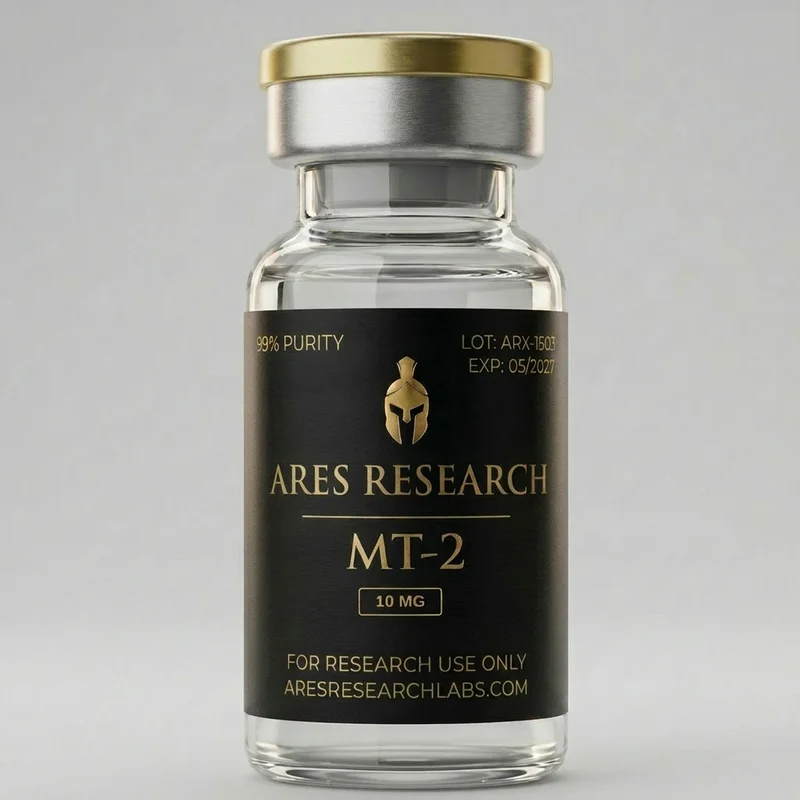
MT-2 (Melanotan-2)
Documentation & standards
- Peptide Purity Verification: Turning a Claim Into Evidence
- Research-Use-Only Compliance: What the Label Obligates
- How to Read a Peptide Certificate of Analysis (COA)

Synthetic α-MSH analog studied in melanocortin receptor signalling and pigmentation-related cellular endpoints.
Mix and match any items — discount applies automatically at checkout.
Earn 34 loyalty points on this purchase · 100 pts = $5 off
Create a Research Account to unlock full batch data, COAs, and priority releases.
Intended strictly for controlled laboratory receptor and pathway research.
What is MT-2 (Melanotan-2)?
MT-2 is a synthetic cyclic analog of α-MSH studied as a broad melanocortin receptor agonist. Its constrained heptapeptide structure is examined in relation to receptor affinity, signalling persistence, and selectivity across the melanocortin receptor family.
Published laboratory work evaluates MC1R, MC3R, MC4R, and MC5R binding and downstream signalling. MC1R-focused models commonly measure cyclic-AMP responses, melanogenic-pathway markers, and pigmentation-related cellular endpoints. Other receptor subtypes are studied to distinguish pathway selectivity within the same compound profile.
MT-2 and MT-1/afamelanotide are distinct compounds with different structures and receptor profiles. This page describes MT-2 only and does not treat the names as interchangeable.
MT-2 COA lookup and verification status
Each vial carries a batch identifier that can be checked against the public documentation library. An MT-2-specific third-party report is not currently posted. The links below provide the available batch lookup and explain the general analytical verification framework without presenting a general report as an MT-2-specific result.
MT-2 research material specifications
| Compound | MT-2 (Melanotan-2) |
|---|---|
| Parent sequence | Synthetic cyclic analog of alpha-melanocyte-stimulating hormone (α-MSH) |
| Class | Broad melanocortin receptor agonist |
| Purity specification | ≥99% |
| Physical form | Lyophilized powder in a sealed glass vial |
| Available vial size | 10mg |
| Storage | Refrigerated, dry, and protected from light; follow batch documentation |
| Testing status | General verification framework available; no MT-2-specific public report currently posted |
| Origin | Shipped domestically from the USA with tracked delivery |
| Intended scope | Laboratory receptor, signalling, and pigmentation-endpoint research only |
MT-2 research questions
+What is MT-2 (Melanotan-2)?
MT-2 (Melanotan-2) is a synthetic cyclic analog of alpha-melanocyte-stimulating hormone (α-MSH). It is studied as a broad melanocortin receptor agonist in controlled receptor-binding and pathway-signalling research.
+Which pathways are examined in MT-2 research?
Laboratory literature examines MT-2 across the melanocortin receptor family, including MC1R, MC3R, MC4R, and MC5R. Studies measure receptor affinity, downstream cyclic-AMP signalling, pathway selectivity, and pigmentation-related cellular endpoints.
+How is MT-2 verified?
Ares Research uses batch identification and general analytical verification standards for catalog material. Search the COA lookup by the batch identifier printed on the vial and review the laboratory and verification framework on the transparency page.
+Is an MT-2-specific COA currently posted?
An MT-2-specific third-party report is not currently posted in the public COA library. The COA lookup and transparency page show the documentation that is available without substituting a general report for a compound-specific result.
+What purity specification applies to MT-2?
The listed release specification is ≥99% purity. Researchers should use the batch identifier and available analytical documentation to confirm the measured result associated with received material.
+How is MT-2 shipped?
MT-2 is shipped from the United States with tracked delivery in protective packaging appropriate for sealed lyophilized research material.
+How should sealed MT-2 be stored?
Keep the sealed lyophilized vial refrigerated, dry, and protected from light. Follow the storage information supplied with the batch for laboratory handling and stability work.
Read the MT-2 (Melanotan-2) research
A laboratory-focused overview of MT-2 structure, melanocortin receptor binding, signalling pathways, and pigmentation-related cellular endpoints.
Read article →A concise identity guide to MT-2 as a synthetic α-MSH analog and melanocortin receptor agonist for controlled laboratory research.
Read article →Researcher Reviews
Sign in with the account that placed your order to leave a verified review.
Ask the Lab
No public questions yet — be the first to ask.