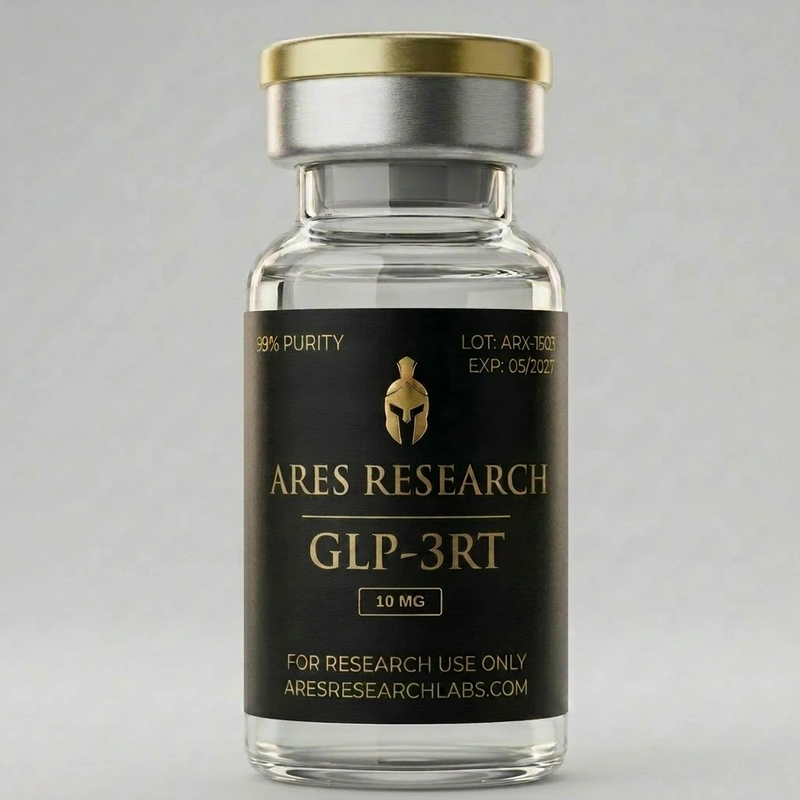
Retatrutide (GLP-3RT)
Same-day shipping — Ships next business day, cutoff 3 PM ET.
≥99% purity verified by independent HPLC and mass spectrometry (MS) through Janoshik Analytical. Intended for laboratory research use only; not for human consumption, diagnosis, or treatment. View transparency report Compliance PDFs
Documentation & standards
- How to Read a Peptide Certificate of Analysis (COA)
- Peptide Storage and Handling: Temperature, Light and Stability
- Research-Use-Only Compliance: What the Label Obligates

Advanced metabolic research compound. Studied in metabolic and energy pathway models. High-purity research-grade material.
Mix and match any items — discount applies automatically at checkout.
Batch transparency
- Batch / lot
- Released with your order
- Testing lab
- Janoshik Analytical
- Purity (HPLC)
- ≥99% target spec
- Identity (MS)
- Available on request
- Report issued
- Available on request
- Full PDF report
- By request
Every request returns a reference number and a live status page. See all published batch records →
For laboratory research use only — not for human or veterinary use.
Earn 49 loyalty points on this purchase · 100 pts = $5 off
Create a Research Account to unlock full batch data, COAs, and priority releases.
Intended strictly for research and laboratory use only. Not for human consumption.
Retatrutide (GLP-3RT) — Triple-Agonist Research Compound
Retatrutide, supplied by Ares Research under the secondary SKU label GLP-3RT, is an investigational compound studied as a triple GLP-1, GIP and glucagon receptor agonist in laboratory models.
GLP-3RT supports controlled investigation of multi-receptor pathway interaction and comparison with semaglutide and tirzepatide research compounds.
Third-party purity testing available upon request.
Key Features
- Elite-tier research compound
- Multi-pathway research focus
- Premium batch purity
- Advanced formulation standards
Retatrutide (GLP-3RT) Research Applications
- Complex metabolic research models
- Multi-pathway signaling studies
- Advanced energy regulation systems
Research Classification
Storage Information
Retatrutide (GLP-3RT) Purity & COA Verification
For laboratory research use only. Not for human consumption, diagnosis, or treatment.
What is retatrutide?
Retatrutide — supplied here as GLP-3RT — is an investigational synthetic peptide described in the scientific literature as a triple receptor agonist. Unlike earlier incretin analogues, it is characterised as engaging three receptors at once: the glucagon-like peptide-1 (GLP-1) receptor, the glucose-dependent insulinotropic polypeptide (GIP) receptor, and the glucagon receptor.
That places it at the end of a clear research lineage. Semaglutide is described as a single agonist acting at the GLP-1 receptor; tirzepatide as a dual agonist adding GIP; retatrutide as the triple agonist that adds glucagon-receptor activity to both. The added glucagon arm is the structural feature that defines the compound and is the principal focus of comparative work on the three molecules.
Published investigational research on retatrutide has examined endpoints in metabolic regulation — glycaemic and lipid handling, energy expenditure signalling — and body-weight endpoints in study populations. Ares Research summarises this literature neutrally for reference purposes only and makes no claim about outcomes, suitability, or effect in any person. GLP-3RT is offered exclusively as a laboratory research material.
Retatrutide (GLP-3RT) product specifications
| Compound | Retatrutide (research designation GLP-3RT) |
|---|---|
| Class | Synthetic peptide — triple receptor agonist (GLP-1 / GIP / glucagon) |
| Purity standard | ≥99% (HPLC, confirmed by mass spectrometry) |
| Physical form | Lyophilised powder, sealed glass vial |
| Vial size | 10mg per vial |
| Storage | Lyophilised: refrigerated, protected from light. Reconstituted: refrigerated. |
| Testing | Third-party COA per batch — identity, purity, heavy metals, endotoxins, sterility |
| Origin | Synthesised and shipped domestically (USA) |
| Intended use | Laboratory research use only — not for human or veterinary use |
Retatrutide COA & third-party verification
Every GLP-3RT batch is tested by an independent analytical laboratory before release. Identity and purity are confirmed by HPLC and mass spectrometry, with heavy metals, endotoxins and sterility screened on the same batch. The resulting Certificate of Analysis is published, not summarised — batch numbers can be looked up and cross-checked against the raw report.
COA and testing documentation is provided for laboratory research use only and does not support human consumption, diagnostic, or therapeutic use.
Retatrutide (GLP-3RT) research questions
+What is retatrutide (GLP-3RT)?
Retatrutide, supplied by Ares Research as GLP-3RT, is an investigational synthetic peptide characterised in the literature as a triple receptor agonist: it binds the GLP-1, GIP and glucagon receptors. It is a laboratory research material only and is not an approved product of any kind.
+How does retatrutide differ from semaglutide and tirzepatide?
The three compounds are distinguished by how many receptors they engage. Semaglutide is described as a single agonist (GLP-1), tirzepatide as a dual agonist (GLP-1 and GIP), and retatrutide as a triple agonist that adds the glucagon receptor. Published research on retatrutide examines metabolic regulation and body-weight endpoints in study models; Ares Research makes no claims beyond what that literature reports.
+What purity is GLP-3RT supplied at?
GLP-3RT is produced to a ≥99% purity standard, verified by HPLC and mass spectrometry on every batch. The measured value for the current batch is published on the product page and on the Certificate of Analysis.
+Is there a COA for retatrutide?
Yes. Every GLP-3RT batch ships with a third-party Certificate of Analysis, and the underlying purity data is published in our COA lookup and on the /transparency page so any batch number can be checked independently.
+What form does GLP-3RT come in and how is it stored?
GLP-3RT is supplied as a lyophilised powder in a sealed glass vial. Lyophilised material is stored refrigerated and protected from light; reconstituted material is kept refrigerated and used within a short window. Handling documentation is included with each shipment.
+How is retatrutide research material shipped?
Orders are synthesised and shipped domestically from the United States with tracked delivery. Material is supplied strictly for laboratory research use and is not for human or veterinary use.
Retatrutide (GLP-3RT) — Compound Information & Scientific Literature
Reference data for laboratory personnel: molecular identity, storage and stability handling, our analytical testing panel, and peer-reviewed literature indexed on PubMed.
Molecular Profile
| Compound | Retatrutide (GLP-3RT) |
|---|---|
| Molecule type | Metabolic Research Compound |
| Class | Metabolic Research Compound |
| Catalog category | Metabolic Research |
| Physical format | Lyophilized vial |
Handling Reference
-20 °C, protected from light and moisture
24 months from date of manufacture in the sealed vial
2-8 °C (refrigerated), do not freeze after reconstitution
Stability studied out to approximately 28 days under continuous refrigeration
Analytical Testing Panel
Verified by Janoshik Analytical — full panel, every batch. Second independent lab confirmation is being added batch by batch.
Quantifies the main peak against related-substance peaks, so the stated purity percentage is measured rather than assumed.
Every Retatrutide (GLP-3RT) lot passes all 8 stages before it is released. Expand a stage to see the method and why we run it.
- Method on the COARP-HPLC (UV 214 nm)Why Ares runs it
Quantifies the main peak against related-substance peaks, so the stated purity percentage is measured rather than assumed.
- Method on the COAQuantitative HPLC mass/concentration assayWhy Ares runs it
Confirms the vial actually contains the labeled amount — purity alone says nothing about how much material is in the vial.
- Method on the COAMass Spectrometry (ESI-MS)Why Ares runs it
Confirms the measured molecular mass matches the declared compound — the check that catches a mislabeled or substituted vial.
- Method on the COAICP-MSWhy Ares runs it
Screens for elemental contaminants carried over from synthesis, reagents, or packaging.
- Method on the COAMembrane filtration, USP <71> methodologyWhy Ares runs it
Checks the finished lyophilized vial for microbial growth after fill and closure.
- Method on the COALAL assay (kinetic chromogenic)Why Ares runs it
Measures bacterial endotoxin load, a contamination marker that purity testing alone will not reveal.
- Method on the COAIndependent batch review against release specificationWhy Ares runs it
Ties the analytical numbers back to the paperwork — the lot you receive is the lot on the certificate.
- Method on the COALC-MS/MS targeted screenWhy Ares runs it
A contamination check most research suppliers never run, and the reason we run it on every batch regardless of compound.
PASS reflects the batch release standard every lot must meet before it ships. Per-lot results are published on that lot's Certificate of Analysis.
Peer-Reviewed References
LY3437943, a novel triple glucagon, GIP, and GLP-1 receptor agonist for glycemic control and weight loss: From discovery to clinical proof of concept
Coskun T et al. · Cell metabolism, 2022 · PMID 35985340
View sourceLY3437943, a novel triple GIP, GLP-1, and glucagon receptor agonist in people with type 2 diabetes: a phase 1b, multicentre, double-blind, placebo-controlled, randomised, multiple-ascending dose trial
Urva S et al. · Lancet (London, England), 2022 · PMID 36354040
View sourceGlucagon-like peptide-1 (GLP-1) receptor agonists and neuroinflammation: Implications for neurodegenerative disease treatment
Kopp KO et al. · Pharmacological research, 2022 · PMID 36372278
View sourceEfficacy and safety of retatrutide, a GIP, GLP-1, and glucagon receptor agonist, in people with type 2 diabetes and inadequate glycaemic control with diet and exercise (TRANSCEND-T2D-1): a double-blind, randomised, phase 3 trial
Bajaj HS et al. · Lancet (London, England), 2026 · PMID 42250575
View sourceIncretins (GLP-1 receptor agonists and dual/triple agonists) and the liver
Newsome PN et al. · Journal of hepatology, 2023 · PMID 37562748
View source
References are listed for literature-identification purposes only. Ares Research is not affiliated with the authors, journals, or institutions cited.
This material is supplied for laboratory and research use only. It is not for human or veterinary use, and it is not a drug, food, or cosmetic. These statements have not been evaluated by the Food and Drug Administration. No information on this page is intended to diagnose, treat, cure, or prevent any condition.
Retatrutide (GLP-3RT) research questions
+What purity standard applies to GLP-3RT?
GLP-3RT (research retatrutide analog) is manufactured to ≥99% purity, validated by HPLC and mass spectrometry with a public batch COA.
+How does GLP-3RT differ from semaglutide and tirzepatide in receptor pharmacology?
GLP-3RT is a triple agonist studied at GLP-1, GIP, and glucagon receptors, while semaglutide is a GLP-1 mono-agonist and tirzepatide is a GLP-1/GIP dual agonist. See /compare/retatrutide-vs-tirzepatide and /compare/retatrutide-vs-semaglutide.
+How is GLP-3RT reconstituted for research?
Add bacteriostatic water slowly against the vial wall and swirl gently until fully dissolved. Use /tools/reconstitution-calculator to compute per-dose volume for your target concentration.
+Is GLP-3RT approved for human use?
No. GLP-3RT is a research analog supplied for in vitro and preclinical laboratory use only.
Read the Retatrutide (GLP-3RT) research
Research-only pharmacokinetic profile of Semaglutide: serum half-life, Tmax, route comparisons, clearance and bioavailability — curated from published preclinical and clinical PK literature.
Read article →Research-only pharmacokinetic profile of Tirzepatide: serum half-life, Tmax, route comparisons, clearance and bioavailability — curated from published preclinical and clinical PK literature.
Read article →Tirzepatide vs cagrilintide compared: dual GIP/GLP-1 incretin vs long-acting amylin analog, mechanism, dosing and stacking research.
Read article →AOD-9604 vs semaglutide for body-composition research: lipolysis-targeted GH fragment vs GLP-1 receptor agonist.
Read article →Semaglutide is a long-acting GLP-1 receptor agonist — a fatty acid–conjugated glucagon-like peptide-1 analogue with a one-week plasma half-life — approved as Ozempic (diabetes) and Wegovy (obesity), and now the subject of the most comprehensive cardiometabolic and emerging neurological research programme of any peptide-class compound in modern pharmacology.
Read article →Tirzepatide is the world's first dual GIP/GLP-1 receptor co-agonist — a 39-amino acid synthetic peptide (Mounjaro; Zepbound) achieving unprecedented weight loss of up to 22.5% in clinical trials, and redefining the ceiling of pharmacological obesity treatment through simultaneous activation of two complementary incretin hormone pathways.
Read article →How Ares compares for GLP-3RT
Independent, documentation-first breakdowns of the vendors researchers most often ask about for this compound. COA verification, US shipping, and sourcing transparency, side by side.
Frequently bought together
Curated complements for this compound — researchers most often pair it with these.
Research Use Disclaimer
Researcher Reviews
Sign in with the account that placed your order to leave a verified review.
Ask the Lab
No public questions yet — be the first to ask.
All testing documentation and COA data are provided for laboratory research use only and are not intended to support human consumption, diagnostic, or therapeutic use.
Independent Certificate of Analysis
Independently tested by Ares Research Analytical Lab. Verified and batch-tracked by Ares Research. Additional reports available upon request.
No fillers. No shortcuts. Only verified compounds.