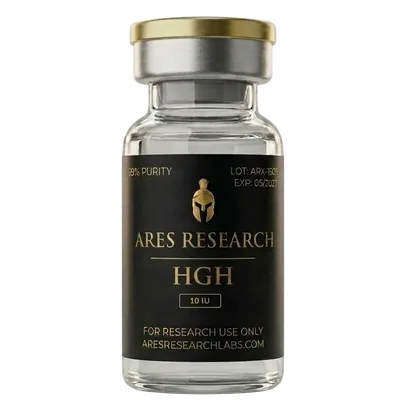
GHRP-2 Research Overview
GHRP-2 (Growth Hormone Releasing Peptide-2; Pralmorelin; KP-102) is a synthetic D-amino acid hexapeptide and high-efficacy GHS-R1a agonist — one of the most potent and thoroughly characterised growth hormone secretagogues in the research peptide class, studied in GH deficiency diagnosis, body composition research, and GH axis pharmacology across species.
Background and Development
GHRP-2 (sequence: D-Ala-D-β-Nal-Ala-Trp-D-Phe-Lys-NH₂) was developed in the late 1980s through structure-activity relationship studies of the founding growth hormone releasing peptide, GHRP-6. The key structural advance over GHRP-6 was the replacement of His at position 1 with D-Ala and the substitution of D-Trp at position 2 with D-β-naphthylalanine — modifications that increase GHS-R1a binding affinity and proteolytic stability while shifting the compound's secondary effects, notably eliminating GHRP-6's pronounced appetite stimulation.
GHRP-2 (also known as Pralmorelin in clinical literature and KP-102 in some research contexts) has received regulatory approval in Japan as a diagnostic agent for assessing pituitary GH secretory reserve — making it one of only a handful of research GHRPs to have achieved any regulatory approval status. Its use as a standardised provocative test for GH deficiency in Japanese endocrinological practice has generated a substantial body of human pharmacokinetic and pharmacodynamic data, distinguishing it from most research-only GHRPs.
- Sequence: D-Ala-D-β-Nal-Ala-Trp-D-Phe-Lys-NH₂
- Molecular Weight: 817.9 Da
- Primary Receptor: GHS-R1a (ghrelin receptor)
- Plasma Half-life: ~15–60 minutes
- Regulatory Status: Approved diagnostic agent (Japan); research compound elsewhere
- Administration Route: Subcutaneous, intravenous (diagnostic)
Mechanism of Action
GHRP-2 activates the growth hormone secretagogue receptor type 1a (GHS-R1a) — the endogenous ghrelin receptor — with high potency and full agonist efficacy. GHS-R1a is a Gq/11-coupled G-protein coupled receptor expressed on pituitary somatotrophs and hypothalamic neurons. GHRP-2 binding initiates phospholipase C activation, IP₃-mediated intracellular calcium release, PKC activation, and voltage-gated calcium channel opening — all converging on GH granule exocytosis from somatotroph cells.
Like all GHRPs, GHRP-2 also acts at the hypothalamic level: it stimulates GHRH release from hypothalamic arcuate neurons and suppresses somatostatin release from periventricular neurons. This dual pituitary/hypothalamic action amplifies the net GH pulse relative to pituitary-only stimulation — the mechanistic basis for the synergistic GH responses observed when GHRP-2 is co-administered with a GHRH analogue.
Off-Target Receptor Activation
GHRP-2 activates GHS-R1a with high selectivity but also engages secondary pathways at research-relevant doses. Its most clinically significant off-target effect is activation of the corticotropic axis: GHRP-2 stimulates ACTH release from pituitary corticotrophs and subsequently elevates plasma cortisol by 20–50% above baseline in human studies — an effect that persists for 30–60 minutes post-injection. Prolactin is also modestly elevated. These co-elevations are not present with Ipamorelin and represent the primary research disadvantage of GHRP-2 versus more selective GHRPs in protocols where hormonal confounders must be minimised.
GH Pulse Characterisation in Research
GHRP-2 produces one of the most robust and reliable GH pulses achievable with any research peptide, making it the preferred compound in provocation testing paradigms designed to document maximal GH secretory capacity. In healthy young adults, a single IV bolus of GHRP-2 (1 µg/kg) produces peak GH responses of 30–80 µg/L within 15–30 minutes — responses comparable in magnitude to the combined GHRH+arginine and ITT (insulin tolerance test) gold standard provocative tests. This pharmacological reliability has driven its adoption as a diagnostic standard in Japan.
The GH pulse produced by GHRP-2 is sharp and discrete: peak at 15–30 minutes post-injection, return to baseline within 90–120 minutes. Pulsatility is preserved between injections, with no accumulation or sustained elevation at standard dosing intervals of 4–8 hours. This kinetic profile is methodologically useful for research designs where a defined, measurable GH pulse at a known time point is required for downstream biological endpoint assessment.
GH Deficiency Diagnostic Research
GHRP-2's most validated clinical application is the combined GHRP-2 + GHRH provocative test for adult growth hormone deficiency (AGHD) diagnosis. In Japan and several European centres, the combination test (simultaneous IV GHRP-2 100 µg + GHRH 1 µg/kg) has been validated as a safe, reproducible, and physiologically meaningful alternative to the insulin tolerance test — which, while the historical gold standard, carries significant hypoglycaemia risk. The combined GHRP-2/GHRH test produces peak GH responses that reliably discriminate GH-sufficient from GH-deficient subjects at validated cut-off values, with sensitivity and specificity comparable to the ITT.
Comparison to Other GHRPs in Research Contexts
- Parameter: GH Pulse Magnitude — GHRP-2: Very High — GHRP-6: High — [Ipamorelin](/catalog/ipamorelin): High — [Hexarelin](/research/hubs/hexarelin): Very High (highest)
- Parameter: Cortisol Elevation — GHRP-2: Significant (+20–50%) — GHRP-6: Moderate — Ipamorelin: Minimal — [Hexarelin](/catalog/hexarelin): Significant
- Parameter: Prolactin Elevation — GHRP-2: Moderate — GHRP-6: Moderate — Ipamorelin: Minimal — Hexarelin: Significant
- Parameter: Appetite Stimulation — GHRP-2: Minimal — GHRP-6: Significant (ghrelin-like) — Ipamorelin: Minimal — Hexarelin: Minimal
- Parameter: GHS-R1a Selectivity — GHRP-2: Moderate (some off-target) — GHRP-6: Moderate — Ipamorelin: High — Hexarelin: Moderate (+ CD36)
- Parameter: GH Desensitisation Risk — GHRP-2: Moderate — GHRP-6: Moderate — Ipamorelin: Low — Hexarelin: High
- Parameter: Diagnostic Validation — GHRP-2: Yes — approved test (Japan) — GHRP-6: No — Ipamorelin: No — Hexarelin: Limited
- Parameter: Research Best Use Case — GHRP-2: Max GH provocation; diagnostic studies — GHRP-6: Appetite/ghrelin axis research — Ipamorelin: Clean GH axis; chronic protocols — Hexarelin: Cardiac research; max potency
GHRP-2 + GHRH Analogue Synergy > > The most potent GH pulse achievable with research peptides is the combination of GHRP-2 with a GHRH analogue (Mod GRF 1-29 or Sermorelin). The mechanistic synergy is well-characterised: GHRP-2 activates GHS-R1a to increase GH pulse amplitude and suppress somatostatin tone, while the GHRH analogue activates GHRH-R to increase GH gene transcription and somatotroph sensitivity. The combined response is 3–5 times the GH output of either agent alone — consistent with the complementary dual regulatory pathway of the GH axis (GHRH = accelerator; ghrelin/GHRPs = brake-release on somatostatin). This combination is the standard protocol in human GH axis maximum stimulation research.
Body Composition and Metabolic Research
The downstream body composition effects of GHRP-2 mirror those of other GH-axis–stimulating peptides: IGF-1 elevation proportional to GH pulse magnitude, with subsequent anabolic effects on skeletal muscle protein synthesis, lipolytic effects on adipose tissue, and modest improvements in bone turnover markers in longer-term studies. In GH-deficient rodent models, chronic GHRP-2 administration significantly restores lean mass, reduces fat mass, and partially normalises IGF-1 levels — comparable in magnitude to equivalent-duration GHRH analogue treatment at matched IGF-1 end-points.
The cortisol co-elevation with GHRP-2 introduces a confounding variable in body composition research: cortisol is catabolic to muscle protein and promotes visceral fat deposition. In short-term acute studies this confounding is minimal, but in chronic administration designs the modest but sustained cortisol elevation associated with multiple daily GHRP-2 doses may attenuate the net anabolic benefit compared to Ipamorelin — a consideration relevant to research protocol design when body composition endpoints are primary.
Research Use Only. Research Use Only — Disclaimer This document is prepared for laboratory and research reference purposes only. GHRP-2 (Pralmorelin) is approved as a diagnostic pharmaceutical in Japan; outside Japan it is a research compound with no approved therapeutic indication. This content does not constitute medical advice, diagnosis, or treatment recommendation. Researchers must comply with all applicable institutional and jurisdictional regulations.
References
- Arvat E, et al. "Endocrine activities of ghrelin, a natural growth hormone secretagogue (GHS), in humans." *J Clin Endocrinol Metab*. 2001;86(3):1171–1174.
- Bowers CY, et al. "Structure-activity relationships of a synthetic hexapeptide that specifically releases growth hormone in vitro and in vivo in rats." *Endocrinology*. 1984;114(5):1537–1545.
- Popovic V, et al. "Hypopituitarism as a consequence of traumatic brain injury and its possible relation with cognitive disabilities and mental distress." *J Endocrinol Invest*. 2004;27(11):1048–1054.
- Katakami H, et al. "Assessment of pituitary GH reserve with GHRP-2 test in Japanese patients suspected of GH deficiency." *Endocr J*. 2006;53(6):791–801.
- Leal-Cerro A, et al. "Effects of GHRP-2 and GH secretion in patients with GH deficiency." *J Clin Endocrinol Metab*. 1999;84(5):1587–1594.
- Laferrère B, et al. "Growth hormone releasing peptide-2 (GHRP-2), like ghrelin, increases food intake in healthy men." *J Clin Endocrinol Metab*. 2005;90(2):611–614.
Related Research Articles
Peptides for Lean Muscle Research 2026
Lean muscle research peaks in summer alongside weight loss research — researchers studying muscle preservation and growth during summer training cycles create consistent demand for the GH-axis and IGF-1 compound categories. Here's the summer 2026 lean muscle research guide.
Best Peptides for Tanning Research — Summer 2026 Guide
Melanocortin research compounds see their sharpest demand peak in summer months — MT-2 is the top-searched compound in this category by a significant margin. Here's the complete summer guide covering mechanism, sourcing, and verification.
HGH Research Alternatives 2026 — Secretagogues, Fragments &
Researchers studying the growth hormone axis have distinct options — each with different mechanisms, evidence bases, and research applications. Here's how CJC-1295, Ipamorelin, Tesamorelin, HGH Fragment 176-191, and direct HGH compare across the key research dimensions.
Skin Peptide Stack Research 2026
Skin biology is addressed by several distinct research peptide mechanisms — collagen gene expression, vascularization, GH-axis IGF-1 signaling, and even the rapid skin laxity changes associated with significant weight loss on GLP compounds. Here's the complete picture.
Related Research Materials
Parent Research Hubs
Neutral, moderated research discussion. Laboratory use only.
More compound guides, hubs, and educational research materials.