
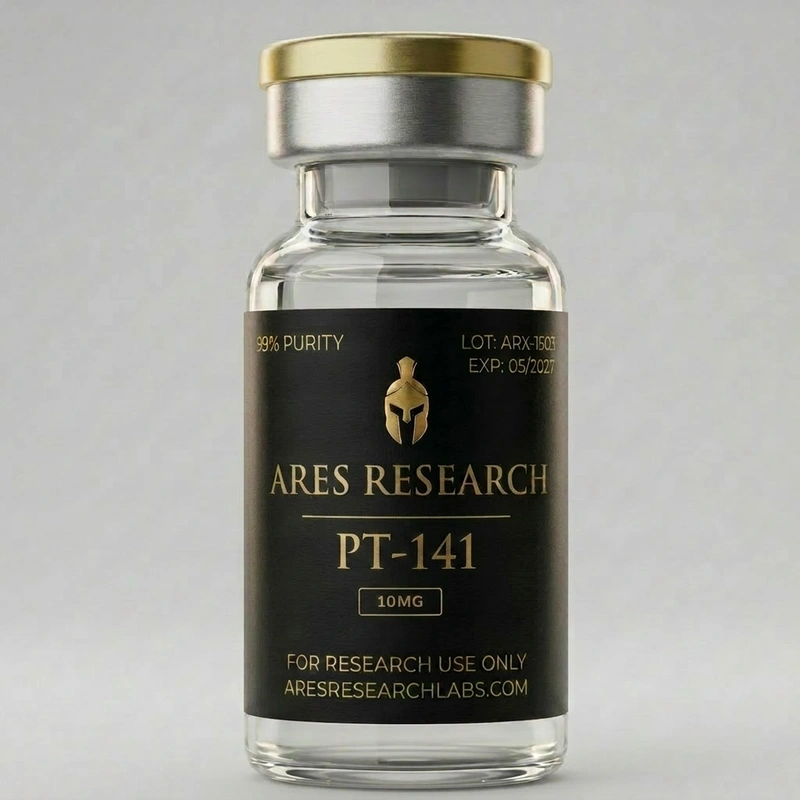
PT-141 (Bremelanotide)
Documentation & standards
- How to Read a Peptide Certificate of Analysis (COA)
- Peptide Storage and Handling: Temperature, Light and Stability
- Research-Use-Only Compliance: What the Label Obligates

Synthetic cyclic heptapeptide melanocortin receptor agonist examined in MC3R, MC4R, receptor-selectivity, and downstream-signaling models.
Mix and match any items — discount applies automatically at checkout.
Earn 64 loyalty points on this purchase · 100 pts = $5 off
Create a Research Account to unlock full batch data, COAs, and priority releases.
Intended strictly for controlled laboratory receptor and pathway research.
What is PT-141 (Bremelanotide)?
PT-141 (bremelanotide) is a synthetic cyclic heptapeptide and melanocortin receptor agonist. Laboratory literature examines its receptor-binding profile and downstream signalling across the melanocortin system.
Research focuses especially on MC3R and MC4R activity, receptor selectivity, ligand-response relationships, and signalling measurements. This listing describes the compound and those pathway-level endpoints only.
The pre-formulated research solution is listed separately as Nasal PT-141.
PT-141 COA and batch verification
A Janoshik Analytical report dated June 2026 is on file for PT-141 10 mg vial material. Match the identifier on the received vial to the public batch lookup. The transparency page explains the identity, purity, and documentation framework.
PT-141 research material specifications
| Compound | PT-141 (bremelanotide) |
|---|---|
| Class | Synthetic cyclic heptapeptide melanocortin receptor agonist |
| Primary research focus | MC3R, MC4R, and melanocortin receptor-signalling measurements |
| Purity specification | ≥99% |
| Physical form | Lyophilized powder in a sealed glass vial |
| Available size | 10 mg vial |
| Testing | PT-141 10 mg Janoshik Analytical report (June 2026) on file |
| Storage | Refrigerated, dry, and protected from light; follow batch documentation |
| Origin | Shipped domestically from the USA with tracked delivery |
PT-141 research questions
+What is PT-141 (bremelanotide)?
PT-141, also called bremelanotide, is a synthetic cyclic heptapeptide melanocortin receptor agonist supplied as laboratory research material.
+Which receptors are examined in PT-141 research?
Published laboratory literature examines PT-141 activity across melanocortin receptors, with particular attention to MC3R and MC4R signalling and receptor-selectivity measurements.
+How does PT-141 differ from MT-2?
Both are melanocortin analogs, but PT-141 is generally examined for its relative MC3R and MC4R activity, while MT-2 is studied across a broader melanocortin-receptor profile.
+Is a PT-141 COA on file?
Yes. A Janoshik Analytical report dated June 2026 is on file for PT-141 10 mg vial material. Match the batch identifier on the received material to the public COA lookup.
+What purity specification applies to PT-141?
The listed purity specification is ≥99%. The batch identifier should be used to locate the corresponding analytical documentation.
+What format is supplied?
PT-141 is supplied as 10 mg of lyophilized research material in a sealed vial. Current pricing and availability appear on this page.
+How should sealed PT-141 research material be stored?
Keep the sealed vial refrigerated, dry, protected from light, and within the conditions stated in its batch documentation.
Read the PT-141 (Bremelanotide) research
A laboratory-focused overview of PT-141 (bremelanotide), its cyclic heptapeptide structure, melanocortin receptor profile, MC3R and MC4R signaling, analytical verification, and research limitations.
Read article →A receptor-level review of PT-141 (bremelanotide), emphasizing MC3R and MC4R agonism, melanocortin receptor selectivity, assay endpoints, and experimental limitations.
Read article →Researcher Reviews
Sign in with the account that placed your order to leave a verified review.
Ask the Lab
No public questions yet — be the first to ask.
Independent Certificate of Analysis
Independently tested by Janoshik Analytical. Verified and batch-tracked by Ares Research. Additional reports available upon request.
No fillers. No shortcuts. Only verified compounds.