
How to Evaluate Peptide Research Literature Sources

TL;DR:
- Evaluating peptide research literature requires systematic assessment of study design, analytical methods, and data transparency to ensure credibility. Researchers must critically review methods before results, validate peptide characterization with multiple orthogonal techniques, and verify source documentation through third-party certificates. Relying solely on AI predictions without experimental validation and proper documentation can lead to misleading conclusions and irreproducible results.
Evaluating peptide research literature sources is defined as the systematic appraisal of study design, analytical characterization methods, data transparency, and reproducibility indicators to determine whether a published peptide study meets the standards required for scientific citation or experimental replication. Researchers who skip this process risk building protocols on flawed data, misinterpreted delivery outcomes, or supplier-reported purity figures that have never been independently confirmed. This guide covers the core criteria, analytical tools, and verification frameworks that support a rigorous literature review process, with specific reference to techniques including Circular Dichroism (CD), LC-MS, Surface Plasmon Resonance (SPR), and AI-driven models such as ApexGO and Aegis.
What are the essential criteria to evaluate peptide research literature sources?
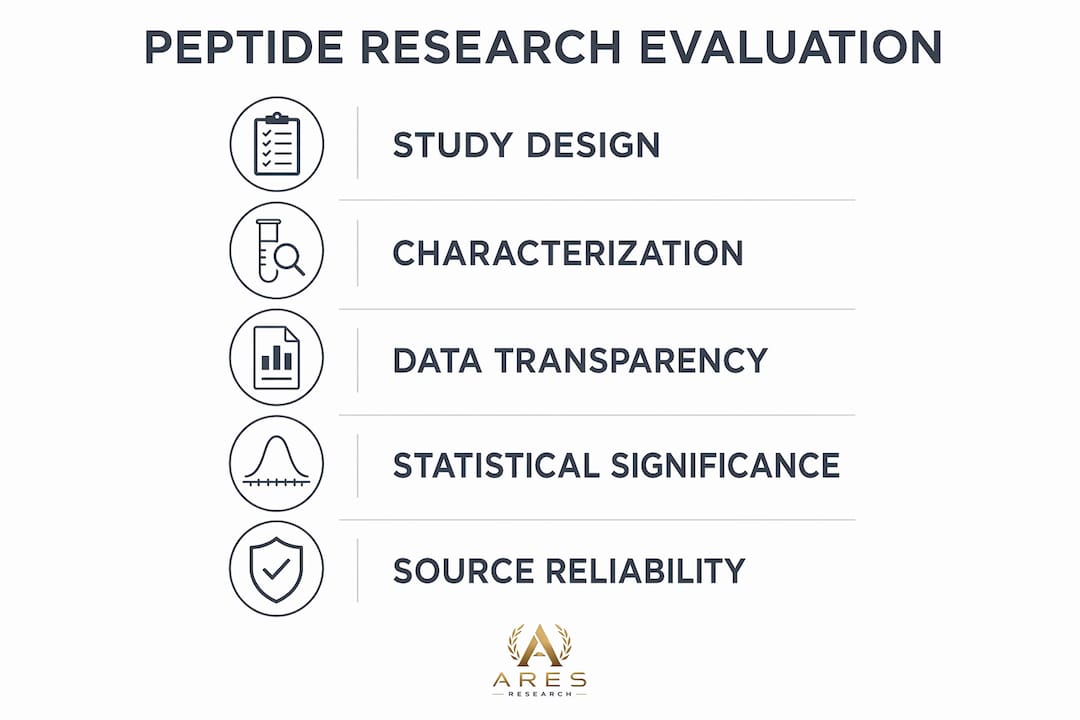
The foundation of any credible literature appraisal rests on four pillars: study design integrity, peptide characterization quality, data transparency, and conflict of interest disclosure. Researchers who assess peptide research articles without checking all four pillars frequently overestimate effect sizes and underestimate reproducibility risk.
Study design features that signal validity
A well-designed peptide study includes pre-specified primary endpoints, randomization procedures, adequate sample sizes, and clearly defined control groups. Evidence tiers clarify peptide research claim validity, with primary endpoints and control groups as the most critical parameters for determining whether a result is confirmatory or merely hypothesis-generating. Secondary endpoints generate hypotheses but require prospective testing before they can support clinical or translational conclusions. Researchers must treat any study that promotes secondary endpoint findings as primary results with significant skepticism.

Sample size is a frequently underreported variable in peptide literature. A systematic review of 19 randomized controlled trials involving 1,341 participants examining oral polypeptides found a mean wrinkle reduction difference of 0.27 at p=0.04. That result is statistically significant, but the effect size is modest, which illustrates why sample size and clinical relevance must be evaluated independently of p-values.
Peptide characterization techniques to look for
Published peptide studies should report structural and purity data from at least two orthogonal analytical methods. The most accepted combination includes:
- Circular Dichroism (CD): Confirms secondary structure (alpha-helix, beta-sheet) and detects conformational changes under physiological conditions.
- LC-MS (Liquid Chromatography-Mass Spectrometry): Provides molecular weight confirmation and impurity profiling at the sequence level.
- SPR (Surface Plasmon Resonance): Quantifies binding kinetics and affinity constants in real time without labeling.
- NMR (Nuclear Magnetic Resonance): Resolves three-dimensional structure and dynamic behavior in solution, particularly for short peptides.
Lack of standardized characterization techniques including CD, LC-MS, and SPR is a documented driver of low reproducibility in peptide literature. Studies that report only HPLC purity without structural confirmation are providing incomplete characterization data. Researchers should treat such studies as preliminary until corroborated by orthogonal methods.
Data transparency and conflict of interest
A Certificate of Analysis (COA) from a third-party laboratory is the minimum documentation standard for any peptide compound referenced in a published study. Studies that rely on manufacturer-supplied purity data without independent verification introduce a systematic bias that is difficult to detect post-publication. Evaluating study design rigor and funding sources helps identify bias and overestimated effect sizes, particularly in industry-sponsored peptide trials.
Pro Tip: When reviewing a peptide study, locate the funding disclosure and COA documentation before reading the Results section. If either is absent, flag the study as requiring corroboration before citation.
How to interpret and analyze peptide study methods and results critically
Critical appraisal of peptide literature requires a non-linear reading strategy. Most researchers default to reading from Abstract to Conclusion, which introduces confirmation bias before the methodological details are examined.
The methods-first reading protocol
Reading the Methods section first prevents confirmation bias and surfaces details about study design, sample size, controls, and endpoints before results are encountered. This approach is particularly important in peptide research, where delivery efficiency and sequence-activity relationships are highly context-dependent. The Abstract compresses findings in ways that frequently omit critical methodological limitations.
A structured reading sequence for peptide studies should proceed as follows:
- Methods: Assess controls, randomization, sample size, and analytical characterization techniques before anything else.
- Results tables and figures: Examine raw data, confidence intervals, and statistical tests independently of the authors’ narrative interpretation.
- Statistical analysis subsection: Confirm whether the primary endpoint was pre-specified or selected post-hoc, and verify that the statistical power calculation is reported.
- Discussion: Read the authors’ interpretation only after forming an independent assessment of the data.
- Abstract and Conclusion: Use these to check whether the authors’ summary accurately reflects the data you have already reviewed.
Evaluating statistical significance and endpoint hierarchy
Statistical significance at p<0.05 does not confirm clinical or translational relevance. Researchers must distinguish between primary endpoints, which are pre-specified and power-calculated, and secondary endpoints, which are exploratory. A study reporting a significant secondary endpoint without a significant primary endpoint has not demonstrated efficacy. It has generated a hypothesis.
Effective peptide delivery depends on cargo and biological context alignment, not sequence alone, which explains many translation failures in peptide literature. A peptide that demonstrates high binding affinity in an SPR assay may still fail in a cellular model due to endosomal entrapment or proteolytic degradation. Researchers must evaluate whether the study’s model system is physiologically relevant to the intended application.
Common methodological pitfalls
Overfitting in computational peptide studies, misleading subgroup analyses in clinical trials, and underpowered in vitro experiments are the three most common methodological failures in peptide literature. Subgroup analyses are particularly problematic because they multiply the probability of false-positive findings. Any subgroup result that was not pre-specified in the study protocol should be treated as hypothesis-generating only.
Pro Tip: Check whether the study was registered in a clinical trial database such as ClinicalTrials.gov before enrollment began. Pre-registration is the strongest available signal that primary endpoints were not selected after data collection.
What are advanced tools and benchmarks for peptide research evaluation?
Computational tools now play a significant role in peptide research, and researchers who analyze peptide studies must understand both the capabilities and the limitations of AI-driven models before citing their outputs.
Ai-driven peptide optimization models
Generative AI models represent a meaningful advance in peptide design. ApexGO achieves an 85% experimental hit rate optimizing peptide antibiotics against Gram-negative pathogens, with 72% success in enhancing antimicrobial activity across 100 optimized sequences. The deep learning model Aegis identifies anticancer peptides with 94.2% accuracy, tested on 138 independent sequences from a validated public dataset of 701 samples. These figures represent a substantial improvement over earlier sequence-based prediction methods.
The table below compares the two models across key evaluation parameters:
| Parameter | ApexGO | Aegis |
|---|---|---|
| Primary application | Antimicrobial peptide optimization | Anticancer peptide identification |
| Reported accuracy | 85% experimental hit rate | 94.2% classification accuracy |
| Dataset size | 100 optimized peptides | 701 validated samples |
| Validation method | Experimental wet lab confirmation | Independent test set of 138 sequences |
| Limitation | Requires experimental validation for translation | Dataset composition affects generalizability |
The QMAP benchmark and model generalization
Inconsistent datasets and evaluation protocols hinder quantification of antimicrobial peptide efficacy, which motivated the development of the QMAP benchmark. QMAP provides a standardized evaluation framework that counteracts overfitting and supports true generalization across diverse peptide sequences. Researchers reviewing computational peptide studies should check whether the model was evaluated against QMAP or an equivalent standardized benchmark, rather than a proprietary or self-constructed test set.
Researchers must integrate AI-driven design tools with experimental validation to reduce attrition in peptide drug discovery. Computational predictions, regardless of reported accuracy, are not substitutes for wet lab confirmation. A study that presents AI-generated peptide candidates without experimental follow-up data should be classified as a design study, not an efficacy study.
How to verify peptide source reliability and literature authenticity
Source reliability encompasses both the quality of the published data and the integrity of the physical peptide compound used in the study. These two dimensions must be evaluated independently.
Documentation standards for peptide compounds
The minimum acceptable documentation package for a research-grade peptide compound includes the following:
- Certificate of Analysis (COA): Must specify purity percentage, analytical method used (HPLC or LC-MS), lot number, and testing laboratory identity.
- HPLC chromatogram: Confirms purity profile and identifies the presence of truncated sequences or aggregation products.
- Mass spectrometry report: Confirms molecular weight to within acceptable mass error tolerances, typically less than 5 ppm for high-resolution instruments.
- Endotoxin testing results: Required for any compound used in cell-based or in vivo models.
Understanding peptide purity standards is foundational to assessing whether a study’s compound quality supports the reported biological activity. A compound with 95% HPLC purity may still contain biologically active impurities that confound results if the impurity profile is not fully characterized.
Cross-validation and replication indicators
Single-source supplier data without independent replication is a recognized reliability risk in peptide research. The most credible studies use peptides sourced from a single, documented supplier and report at least one independent replication of the key finding, either within the same paper or by citation of a prior study using the same compound.
Researchers should apply the following cross-validation checks when reviewing peptide literature:
- Confirm that the supplier’s COA matches the purity and characterization data reported in the Methods section.
- Check whether the study cites prior work using the same peptide sequence and supplier, which provides an indirect replication signal.
- Verify that the analytical method used for purity determination is appropriate for the peptide’s molecular weight and sequence complexity.
A professional guide to sourcing and verification in 2026 confirms that single-source procurement with documented chain of custody is the current operational standard for research-grade peptide compounds. Researchers who cite studies using unverified or multi-source compounds should note this as a limitation in their own literature review.
Detailed analytical techniques for peptide verification, including CD, LC-MS, and SPR, are now considered standard practice for quality confirmation in academic and pharmaceutical research contexts. Studies that omit these methods from their characterization section should be flagged for incomplete documentation.
Pro Tip: When a study reports peptide purity without specifying the analytical method, contact the corresponding author to request the raw COA data. Peer review does not routinely verify supplier documentation, so this step falls to the citing researcher.
Key takeaways
Rigorous evaluation of peptide research literature requires systematic appraisal of study design, characterization methods, data transparency, and source documentation before any study is cited or replicated.
| Point | Details |
|---|---|
| Methods section first | Read study design, controls, and endpoints before examining results to avoid confirmation bias. |
| Orthogonal characterization | Require CD, LC-MS, and SPR data together; single-method purity reporting is insufficient for citation. |
| AI tools need wet lab confirmation | ApexGO and Aegis show high accuracy, but computational predictions require experimental validation before use. |
| COA documentation is mandatory | Third-party COA with HPLC chromatogram and mass spec data is the minimum standard for compound verification. |
| Endpoint hierarchy matters | Primary endpoints confirm efficacy; secondary endpoints generate hypotheses and require prospective testing. |
The evaluation habit most researchers skip
The single most consistent gap in peptide literature review practice is the failure to interrogate the Methods section before forming an opinion about the results. Researchers at all career stages tend to read the Abstract, scan the figures, and then decide whether the study supports their hypothesis. This sequence is the opposite of rigorous appraisal.
From the perspective of Aresresearchlab, the more consequential problem is what happens downstream of that shortcut. When a researcher cites a study with undisclosed funding bias, incomplete characterization data, or a secondary endpoint promoted as a primary finding, that error propagates through every subsequent study that cites the same paper. The reproducibility problem in peptide therapeutics is not primarily a laboratory problem. It is a literature evaluation problem.
The field’s growing reliance on AI models like Aegis and ApexGO adds a new dimension to this challenge. These tools report impressive accuracy figures, but accuracy on a benchmark dataset is not the same as translational relevance. A model trained on a curated dataset of 701 validated sequences may perform very differently on the specific peptide class a researcher is studying. The QMAP benchmark exists precisely because the field recognized that self-reported model performance was insufficient for meaningful comparison.
The practical implication is straightforward. Researchers should treat AI-generated peptide candidates the same way they treat any other preliminary finding: as a starting point for experimental validation, not a conclusion. The quantification accuracy of peptide methods determines whether a study’s biological claims are credible, and no computational model changes that requirement.
The researchers who produce the most reproducible work are not necessarily the ones with access to the most advanced tools. They are the ones who apply the same critical standards to every source they cite, regardless of the journal’s impact factor or the model’s reported accuracy.
— Ares
How Aresresearchlab supports your peptide literature review
Aresresearchlab provides researchers with the documentation infrastructure and verified compound access needed to apply the evaluation standards described in this article.

The Research Compound COA Checklist gives researchers a structured framework for verifying that any peptide compound referenced in a study meets third-party documentation standards, including HPLC chromatogram review, mass spectrometry confirmation, and endotoxin testing requirements. The Laboratory Compound Documentation Standards guide details the full documentation chain required for research-grade compounds in 2026. Researchers who need access to verified, third-party tested peptide compounds can review the full research compound catalog to confirm purity grades and available characterization data before procurement.
FAQ
What does it mean to evaluate peptide research literature sources?
Evaluating peptide research literature sources means systematically assessing study design, analytical characterization methods, data transparency, and reproducibility indicators to determine whether a study is credible enough to cite or replicate.
Why should researchers read the methods section before the abstract?
Reading Methods first prevents confirmation bias by exposing study design flaws, inadequate controls, and underpowered sample sizes before the authors’ conclusions are encountered.
What characterization methods should a credible peptide study report?
A credible study should report data from at least two orthogonal methods, with CD, LC-MS, and SPR representing the current standard combination for structural and purity confirmation.
How do AI tools like ApexGO and aegis fit into peptide literature evaluation?
ApexGO and Aegis demonstrate strong benchmark performance, but AI models require experimental validation before their outputs can be treated as efficacy evidence in a literature review.
What is the minimum documentation standard for a research-grade peptide compound?
The minimum standard is a third-party Certificate of Analysis specifying purity percentage, analytical method, lot number, and testing laboratory identity, supported by an HPLC chromatogram and mass spectrometry confirmation.