What Does a Certificate of Analysis Include?

TL;DR:
- A Certificate of Analysis (COA) is a laboratory document that verifies the identity, purity, and safety of a product batch. It must include specific information such as product details, test methods, results, compliance status, signatures, and accreditation. Regulatory standards like ISO/IEC 17025 and cGMP enforce the completeness and authenticity of COAs for quality assurance and compliance.
A Certificate of Analysis (COA) is a formal, laboratory-issued document that reports the test results, specifications, and compliance status of a specific product batch, providing verified assurance of product identity, purity, and safety. Understanding what does a certificate of analysis include is not optional for laboratory professionals and quality assurance teams. It is a prerequisite for regulatory acceptance, supply chain integrity, and defensible research outcomes. COAs appear across pharmaceuticals, food science, chemical manufacturing, and research materials, where product verification supports traceability, compliance, and buyer confidence.
What does a certificate of analysis include?
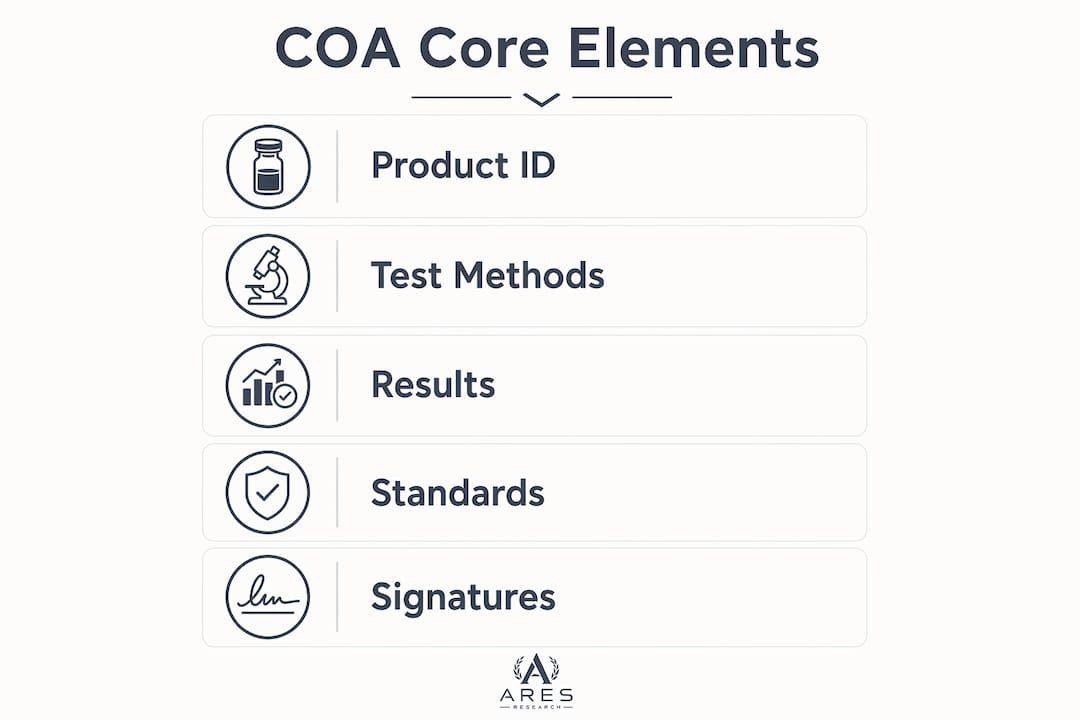
A COA must contain six core categories of information to be considered complete and compliant. Each category serves a distinct function in establishing product identity, analytical validity, and regulatory traceability. According to established documentation standards, a legitimate COA must include product identification, test methods, results versus specifications, a compliance statement, and authorized signatures.
Product identification fields
Product identification is the first section of any COA and establishes the exact material being certified. This section includes the product name, catalog or reference number, batch or lot number, manufacturing date, and expiration or retest date. Without a unique batch number, the document cannot be tied to a specific production run, which makes it legally and scientifically meaningless.

Analytical testing methods
The methods section documents how each test was performed. Common testing methods reported include HPLC (High-Performance Liquid Chromatography), GC-MS (Gas Chromatography-Mass Spectrometry), ICP (Inductively Coupled Plasma) for metals, UV-Vis spectrophotometry, and microbial enumeration following recognized compendial standards or validated in-house protocols. Method references are not administrative formalities. They establish reproducibility and legal defensibility of every result on the document.
Test results and specifications
The results section is the analytical core of the COA. It presents specifications (the acceptable range), actual measured values, units of measurement, and a compliance status for each parameter. COA test results use terms like “pass,” “fail,” and “ND” (not detected), alongside quantitative units such as ppm, ppb, or percentage. Understanding these values is the primary skill required for accurate product evaluation.
The table below summarizes the standard certificate of analysis components found in a compliant document:
| COA Component | Description | Common Format |
|---|---|---|
| Product Name and Lot Number | Unique identifiers for the specific batch | Alphanumeric string |
| Manufacturing and Expiry Dates | Establishes product age and validity window | DD/MM/YYYY or MM/YYYY |
| Test Method References | HPLC, GC-MS, ICP, microbial enumeration | Method name and version |
| Specifications | Acceptable range for each parameter | Numeric range or limit |
| Actual Results | Measured values from laboratory testing | Numeric value with units |
| Compliance Status | Pass/fail or ND designation per parameter | Text or coded indicator |
| Authorized Signature and Date | Personnel authorization and date of issuance | Handwritten or digital signature |
| Laboratory Accreditation | ISO/IEC 17025 or equivalent certification number | Accreditation body and number |
Pro Tip: When reviewing a COA, cross-reference the method version listed against the current compendial edition (e.g., USP, EP, or ICH guidelines). An outdated method reference can invalidate the result for regulatory submission purposes.
What standards and regulations govern COA contents?
Regulatory frameworks and accreditation standards define what must appear on a COA and determine whether that document will be accepted by auditors, regulators, or downstream customers. Two frameworks dominate this space in 2026: ISO/IEC 17025 and current Good Manufacturing Practice (cGMP).
Iso/iec 17025 accreditation
ISO/IEC 17025 is the international standard for laboratory competence. ISO/IEC 17025 accreditation is recognized globally and by regulatory bodies including the FDA and EMA as the benchmark for laboratory credibility. A COA issued by an ISO/IEC 17025-accredited laboratory carries significantly more weight in regulatory submissions than one issued by a non-accredited facility. The accreditation number should appear on the document itself, typically in the header or footer.
cGMP requirements for signatures and dates
Current Good Manufacturing Practice regulations require that COAs be signed and dated by authorized personnel. Unsigned or undated COAs fail basic quality management requirements and should be rejected outright. This is not a procedural technicality. An unsigned COA has no legal traceability and cannot be used in an audit, regulatory submission, or dispute resolution.
The following conditions indicate a COA that does not meet minimum compliance standards:
- No batch or lot number present
- Missing or illegible authorized signature
- No date of analysis or issuance
- Test methods not referenced or described
- No specification limits provided alongside actual results
- Laboratory accreditation status absent or unverifiable
Third-party vs. in-house laboratory coas
Third-party laboratory COAs carry greater credibility than in-house documents because they are generated by an independent entity with no commercial interest in the outcome. In-house COAs can be valid when the issuing laboratory holds ISO/IEC 17025 accreditation and follows documented quality management procedures. For research materials, genomics and clinical lab outsourcing practices illustrate how third-party verification has become the standard expectation across regulated sectors.
Pro Tip: Request the laboratory’s accreditation certificate directly from the issuing body’s public registry rather than relying solely on the number printed on the COA. Accreditation status can lapse without notice.
What contaminants and tests appear on a COA?
The contaminant screening section of a COA reflects the risk profile of the product category and the regulatory requirements of the target market. Five contaminant categories are standard in chemical and research material analysis as of 2026: heavy metals, residual solvents, microbiological contaminants, pesticides, and mycotoxins.
How results are presented
Each contaminant category uses specific units and reporting conventions. Heavy metals are typically reported in ppm or ppb using ICP-MS or ICP-OES. Residual solvents are reported in ppm via GC headspace analysis. Microbiological results are expressed as colony-forming units per gram (CFU/g) or as presence/absence for specific pathogens such as E. coli and Salmonella. Pesticide residues and mycotoxins are reported in ppb, often against regulatory thresholds set by bodies such as the FDA, EFSA, or USP.
A “pass” result means the measured value falls within the specification limit. A “fail” result means it exceeds that limit and the batch is non-conforming. “ND” (not detected) indicates the analyte was below the method’s limit of detection, which is a favorable result but must be interpreted alongside the stated detection limit.
The table below compares common contaminant categories with their typical regulatory thresholds and reporting units:
| Contaminant Category | Common Analytes | Typical Threshold | Reporting Unit |
|---|---|---|---|
| Heavy Metals | Lead, arsenic, cadmium, mercury | 0.5–10 ppm (varies by matrix) | ppm or ppb |
| Residual Solvents | Methanol, ethanol, acetonitrile | Class 1: <2 ppm; Class 2: <410 ppm | ppm |
| Microbiological | E. coli, Salmonella, total aerobic count | Absence per 10g; <1,000 CFU/g | CFU/g or presence/absence |
| Pesticides | Organophosphates, pyrethroids | 0.01–0.1 ppm (regulatory matrix-specific) | ppb |
| Mycotoxins | Aflatoxins B1, B2, G1, G2 | <2 ppb (aflatoxin B1, EU limit) | ppb |
Purity and assay values
Purity and assay results are reported as a percentage of the target compound relative to the total sample mass. HPLC is the most widely used method for purity determination in research compounds and pharmaceuticals. A purity value of 98.5% means 98.5% of the measured sample mass is the target compound, with the remaining 1.5% comprising impurities, degradation products, or residual synthesis byproducts.
Pro Tip: Always check the purity method’s specificity. An HPLC purity result is only as reliable as the column chemistry and wavelength used. A method not validated for your specific compound may overestimate purity by failing to resolve structurally similar impurities.
How to interpret and apply COA data in QA workflows
Receiving a COA is not the final step. Applying it correctly within laboratory and quality assurance workflows requires systematic verification and documented decision-making. The following steps represent current best practice for COA review and application.
-
Verify batch number alignment. Confirm that the lot or batch number on the COA matches the number printed on the product label or packaging. A mismatch between lot numbers uncouples the certification from the actual product, undermining the entire quality assurance process.
-
Confirm the COA is batch-specific. Generic or template COAs that do not reference a specific production lot are not acceptable for regulated applications. Batch-specific COAs are the standard expectation in quality-conscious procurement and should be requested explicitly from suppliers.
-
Review the test methodology. Confirm that the methods listed are appropriate for the compound class and are either compendial (USP, EP, ICH) or validated in-house. An unvalidated or undescribed method cannot support a defensible compliance claim.
-
Verify laboratory accreditation. Cross-check the accreditation number against the issuing body’s public registry. ISO/IEC 17025 accreditation is the accepted global standard. For research materials, the COA batch lookup process at Aresresearchlab provides direct access to third-party verified documentation.
-
Evaluate out-of-specification results. Any parameter marked “fail” or exceeding its specification limit requires a formal investigation before the batch is accepted or used. Document the finding, initiate a deviation report, and determine whether the out-of-specification result affects the intended use of the material.
-
Integrate COA data into audit records. Store COAs with batch traceability records, incoming inspection logs, and supplier qualification files. Regulatory auditors expect COAs to be retrievable by batch number and linked to corresponding purchase orders and usage records.
-
Reject outdated or generic COAs. A COA issued for a previous lot, or one that carries no lot number at all, provides no assurance about the material currently in hand. This is one of the most common and consequential errors in laboratory procurement practice.
The laboratory compound documentation standards published by Aresresearchlab provide a structured framework for integrating these steps into daily QA operations.
Key takeaways
A COA is only as reliable as the specificity of its batch reference, the credibility of its issuing laboratory, and the completeness of its analytical data.
| Point | Details |
|---|---|
| Batch-specific documentation | Always match the COA lot number to the physical product label before accepting any material. |
| ISO/IEC 17025 accreditation | Verify the issuing laboratory’s accreditation status through a public registry, not just the printed number. |
| Method references matter | Test methods must be named, versioned, and validated to support defensible compliance claims. |
| Contaminant screening scope | A complete COA covers heavy metals, residual solvents, microbiological agents, pesticides, and mycotoxins. |
| Signature and date requirements | Unsigned or undated COAs fail cGMP requirements and must be rejected without exception. |
Why COA rigor has become non-negotiable in 2026
From where Aresresearchlab sits in the research materials space, the single most consistent failure we observe is not outright fraud. It is complacency. Laboratories and procurement teams accept COAs that are technically present but analytically insufficient. A document with no method references, a generic lot number, and a missing accreditation number is not a COA in any meaningful sense. It is a formatted assertion.
The demand for batch-level accuracy has intensified significantly over the past two years. Regulatory bodies including the FDA and EMA have tightened expectations around traceability documentation, and third-party auditors now routinely flag COAs that lack ISO/IEC 17025 accreditation references. We have seen research programs delayed and procurement contracts voided because a supplier’s COA did not meet the receiving laboratory’s documentation standards.
The most common error we encounter in COA evaluation is accepting purity data without scrutinizing the method. An HPLC purity result of 99% sounds definitive. But if the method was not validated for the specific compound, or if the detector wavelength was not optimized, that number may reflect the chromatographic profile of the dominant peak rather than true compound purity. Method scrutiny is not optional. It is the difference between a number and a fact.
Integrating COA review into daily QA routines, rather than treating it as a receiving-dock formality, changes the quality posture of a laboratory. A COA reviewed at the point of use, cross-referenced against the batch record and the supplier’s accreditation status, functions as a live quality control instrument. A COA filed unread is a liability.
The research compound COA checklist published by Aresresearchlab was developed specifically to address these gaps, providing a structured review protocol that QA teams can apply consistently across all incoming materials.
— Ares
How Aresresearchlab supports coa-compliant research

Aresresearchlab supplies high-purity research compounds with full third-party COA documentation for every batch. Each product in the catalog is tested by ISO/IEC 17025-accredited laboratories, with results covering purity by HPLC, heavy metals, residual solvents, and microbiological screening where applicable. The COA is batch-specific, signed, dated, and retrievable by lot number through the Aresresearchlab platform.
For laboratory professionals and QA teams who require documentation that meets 2026 regulatory expectations, the high-purity compound grading standards resource details the exact criteria applied to every material Aresresearchlab provides. Researchers can also access the research compound COA checklist to verify incoming materials against a structured compliance framework before use.
FAQ
What is the primary purpose of a certificate of analysis?
A COA provides legal attestation that a specific product batch meets defined quality, purity, and safety specifications. It supports traceability, regulatory compliance, and informed procurement decisions across pharmaceuticals, food, and research material industries.
How do i verify that a COA is legitimate?
Confirm the document includes a unique batch number, named test methods, specification limits with actual results, an authorized signature and date, and a verifiable ISO/IEC 17025 accreditation number. Cross-check the accreditation status against the issuing body’s public registry.
What does “ND” mean on a certificate of analysis?
“ND” stands for “not detected,” meaning the analyte was below the method’s stated limit of detection. This is a favorable result, but the interpretation depends on the detection limit being sufficiently low to meet the applicable regulatory threshold.
Why must the COA batch number match the product label?
A mismatch between the COA lot number and the product packaging lot number means the certificate does not apply to the material in hand. This uncouples the quality certification from the actual product and invalidates the assurance the document is intended to provide.
Is a COA from an in-house laboratory acceptable?
An in-house COA is acceptable only if the issuing laboratory holds ISO/IEC 17025 accreditation and follows documented quality management procedures. Third-party COAs are preferred in regulated contexts because they eliminate the commercial conflict of interest inherent in self-certification.