
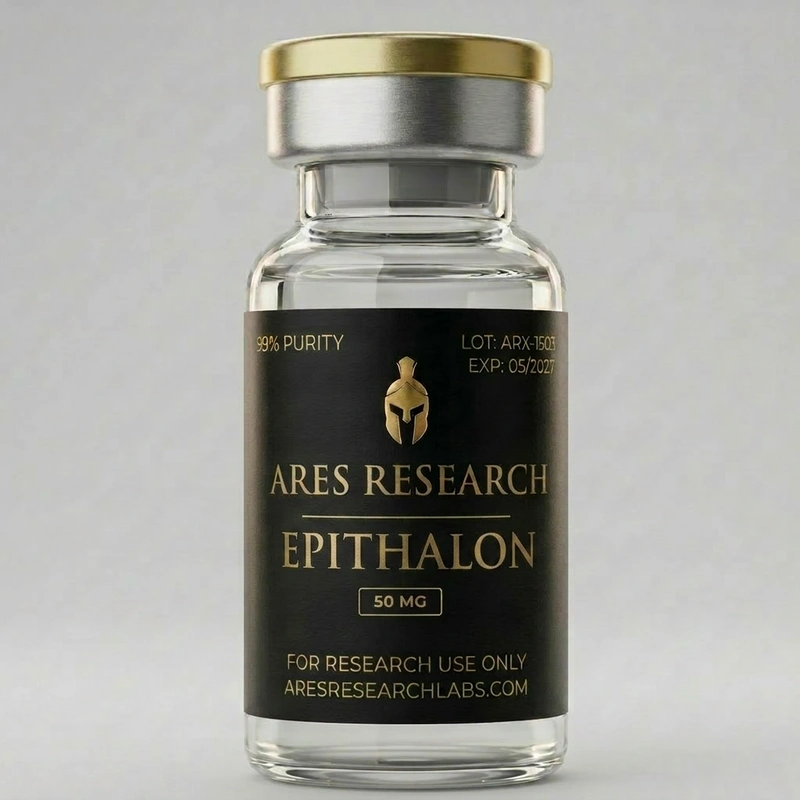
Epithalon
Documentation & standards
- Research-Use-Only Compliance: What the Label Obligates
- How to Read a Peptide Certificate of Analysis (COA)
- Peptide Storage and Handling: Temperature, Light and Stability

Epithalon (Epitalon) is the synthetic tetrapeptide Ala-Glu-Asp-Gly, supplied for telomerase-activity, pineal-peptide, and cellular-senescence research endpoints.
Mix and match any items — discount applies automatically at checkout.
Earn 39 loyalty points on this purchase · 100 pts = $5 off
Create a Research Account to unlock full batch data, COAs, and priority releases.
Intended strictly for controlled laboratory receptor and pathway research.
What is Epithalon (Epitalon)?
Epithalon, also spelled Epitalon, is a synthetic tetrapeptide with the sequence Ala-Glu-Asp-Gly. It was developed from pineal-peptide research and is supplied here as laboratory reference material.
Controlled research examines telomerase activity, telomere-associated measurements, pineal signaling, and cellular-senescence endpoints. This page describes the compound and those experimental endpoints without extending the evidence beyond the studied systems.
Epithalon COA and batch verification
Two attached Janoshik Analytical report images dated June 2026 document Epithalon 10 mg vial material from batch 988947. The reports list 9.73 mg content and 99.140% purity. Match the identifier on the received material to the public lookup; a separate database record without an attached report is not presented here as independently viewable evidence.
Epithalon research material specifications
| Compound | Epithalon (Epitalon) |
|---|---|
| Sequence | Ala-Glu-Asp-Gly |
| Class | Synthetic tetrapeptide |
| Research focus | Telomerase activity, pineal-peptide signaling, and cellular-senescence endpoints |
| Purity specification | ≥99% |
| Physical form | Lyophilized powder in a sealed glass vial |
| Available vial sizes | 10 mg and 50 mg |
| Attached reports | Two Janoshik Analytical report images dated June 2026 for Epithalon 10 mg, batch 988947 |
| Reported result | 9.73 mg content and 99.140% purity |
| Storage | Refrigerated, dry, and protected from light; follow batch documentation |
Pineal-peptide research context
Sibarov DA et al., “Epitalon influences pineal secretion in stress-exposed rats in the daytime,” Neuro Endocrinology Letters (2002), PMID 12500171. Listed for pineal-signaling research context only.
Epithalon research questions
+What is Epithalon?
Epithalon, also spelled Epitalon, is the synthetic tetrapeptide Ala-Glu-Asp-Gly supplied here as laboratory research material.
+Why are Epithalon and Epitalon both used?
Epithalon and Epitalon are alternate transliterations used for the same Ala-Glu-Asp-Gly tetrapeptide in catalogs and published research.
+Which endpoints are examined in Epithalon research?
Published research examines telomerase activity, telomere-associated measurements, pineal-peptide signaling, and cellular-senescence endpoints in defined experimental systems.
+Are Epithalon analytical reports available?
Yes. Two attached Janoshik Analytical report images from June 2026 document Epithalon 10 mg vial material from batch 988947, reporting 9.73 mg content and 99.140% purity. Researchers should match their unit identifier through the public batch lookup.
+What Epithalon formats are available?
Epithalon is offered as sealed lyophilized research material in 10 mg and 50 mg vial sizes. Current offers appear on this page.
+What is the listed purity specification?
The catalog specification is ≥99%. A specification is distinct from a batch result, so the documentation associated with the received unit should be reviewed separately.
Read the Epithalon research
Research guide to Epithalon (Epitalon), the Ala-Glu-Asp-Gly tetrapeptide, covering telomerase activity, pineal-peptide signaling, cellular-senescence endpoints, and evidence limitations.
Read article →Mechanistic research on Epitalon examines telomerase activity, telomere-associated measurements, pineal-peptide signaling, and cellular-senescence markers.
Read article →A research-focused review of Epitalon pharmacokinetic evidence, analytical constraints, sampling design, clearance measurements, and current data gaps.
Read article →Compare Epitalon telomerase and pineal-peptide research with SS-31 cardiolipin and mitochondrial-bioenergetics research across distinct experimental endpoints.
Read article →Researcher Reviews
Sign in with the account that placed your order to leave a verified review.
Ask the Lab
No public questions yet — be the first to ask.
Independent Certificate of Analysis
Independently tested by Janoshik Analytical. Verified and batch-tracked by Ares Research. Additional reports available upon request.
No fillers. No shortcuts. Only verified compounds.