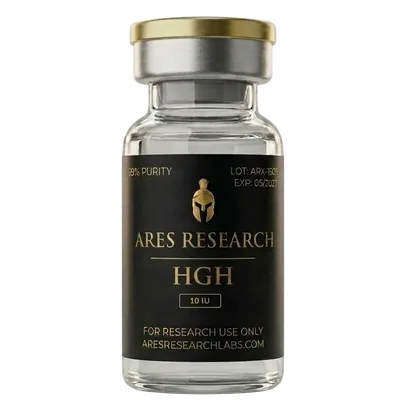
HGH (Somatropin) Benefits and Side Effects: A Research Guide
Comprehensive research guide on recombinant human growth hormone (somatropin): GH-receptor signalling, IGF-1 axis effects, body-composition and longevity literature, and the documented side-effect profile.
HGH (Somatropin) Benefits and Side Effects: A Research Guide
Recombinant human growth hormone (rhGH, somatropin) is a 191-amino-acid recombinant protein produced via recombinant DNA technology in *E. coli* or mammalian cells. It is bioidentical to pituitary-derived growth hormone (GH) and is the single most extensively studied endocrine compound in the published literature, with FDA approvals dating to 1985 and tens of thousands of indexed publications.
This guide summarises what the published research literature reports about somatropin's mechanism, outcomes investigated, and its side-effect profile. It is written for laboratory researchers and is not medical advice.
Mechanism of Action
Somatropin binds the dimeric growth hormone receptor (GHR) on hepatocytes, adipocytes, myocytes and chondrocytes. Receptor dimerisation activates JAK2, which phosphorylates STAT5 (the canonical GH signal), as well as the MAPK/ERK and PI3K/Akt pathways. STAT5 translocates to the nucleus and induces hepatic [IGF-1](/research/hubs/igf-1-lr3) transcription, which mediates the majority of GH's anabolic effects.
Key downstream observations in the literature:
- IGF-1 induction. Hepatic IGF-1 rises within 24 hours of administration; serum IGF-1 is the standard biomarker for GH activity.
- Lipolysis. GH activates hormone-sensitive lipase and reduces lipoprotein-lipase activity in adipose tissue, mobilising free fatty acids.
- Protein synthesis. Combined GH + IGF-1 signalling drives nitrogen retention and skeletal-muscle protein synthesis.
- Carbohydrate handling. GH is counter-regulatory to insulin; supraphysiological doses reduce peripheral glucose uptake.
- Bone and cartilage. IGF-1 mediates longitudinal bone growth at the epiphyseal plate (until closure) and supports osteoblast activity throughout life.
Benefits Investigated in Research
The published research-grade HGH literature spans pediatric GH-deficiency, adult GH-deficiency, AIDS-wasting, short bowel syndrome, Turner syndrome, Prader-Willi syndrome, and a large body of anti-aging and body-composition research.
Body Composition
Multiple controlled studies (notably Rudman et al., NEJM 1990) report:
- 8–14% reduction in adipose mass
- 6–9% increase in lean body mass
- Reduced visceral adipose tissue (especially with tesamorelin in HIV-lipodystrophy research)
Pediatric and Adult GH-Deficiency
- Restoration of linear growth velocity in GH-deficient pediatric cohorts.
- Improvements in lean mass, exercise capacity and lipid profile in adult GH-deficient cohorts.
Bone Mineral Density
Long-term GH replacement is associated with increases in lumbar-spine and femoral-neck BMD in adult GH-deficient cohorts.
Wound Healing and Catabolic States
GH is investigated as an anti-catabolic agent in burn injury, major surgery and critical-illness models.
Anti-Aging Research
Somatopause (age-related decline in GH/IGF-1) drives a large research literature on whether restoration to youthful IGF-1 ranges affects body composition, skin quality and functional capacity. Results are mixed and dose-dependent.
Side-Effect Profile
The HGH side-effect profile is among the best-characterised of any peptide therapeutic. Most adverse effects are dose-dependent and reverse on dose reduction.
Common (≥10% in supraphysiological dosing studies)
- Fluid retention and peripheral edema — driven by GH's antinatriuretic effect on the renal tubule.
- Arthralgias and myalgias — often transient, frequently in the small joints of the hand.
- Carpal tunnel syndrome — secondary to soft-tissue swelling at the wrist; reversible.
- Paraesthesias — typically distal; resolve on dose adjustment.
Metabolic
- Insulin resistance and hyperglycemia. GH is counter-regulatory to insulin. Supraphysiological dosing impairs peripheral glucose uptake and can precipitate frank glucose intolerance.
- Reduced free T4 / increased T3 — GH alters thyroid-hormone deiodination; some research protocols monitor or supplement.
Less Common
- Gynecomastia — primarily in adult-male protocols.
- Hypertension — typically mild and related to fluid expansion.
- Headache and benign intracranial hypertension (pediatric literature).
Contraindications in the Published Literature
- Active malignancy (GH/IGF-1 is mitogenic).
- Proliferative diabetic retinopathy.
- Acute critical illness following major surgery or trauma (associated with increased mortality in two large ICU trials — Takala 1999).
Dosing in the Published Literature
- Pediatric GH-deficiency: ~0.025–0.05 mg/kg/day.
- Adult GH-deficiency replacement: ~0.15–0.3 mg/day titrated to IGF-1 within age-adjusted reference range.
- Body-composition / anti-aging research: highly variable; supraphysiological protocols use higher doses with greater side-effect liability.
The standard unit conversion is 1 mg ≈ 3 IU.
HGH vs Peptide GH Secretagogues
| Approach | Mechanism | Pulsatility | Negative feedback | | --- | --- | --- | --- | | HGH (somatropin) | Exogenous GH | Sustained, non-pulsatile | Suppresses endogenous GH | | GHRH analogues (sermorelin, tesamorelin, CJC-1295) | Stimulate pituitary GHRH-R | Preserved | Intact | | GHRPs (ipamorelin, hexarelin, GHRP-2/6) | Ghrelin-mimetic, stimulate GH release | Preserved | Intact |
See the dedicated HGH vs Peptide GH Stimulation comparison guide for the full review.
Conclusion
Somatropin remains the reference compound for the GH/IGF-1 axis. Its benefits in deficiency states and body-composition research are well documented, as is its dose-dependent side-effect profile dominated by fluid retention, arthralgias and insulin resistance. For research use only.
Research Use Only. This material is provided for laboratory and educational research and is not medical advice. Not for human or veterinary use.
Running the numbers for a protocol? Use the research calculators to convert mg, mL, and syringe units.
Related Research Articles
Peptides for Lean Muscle Research 2026
Lean muscle research peaks in summer alongside weight loss research — researchers studying muscle preservation and growth during summer training cycles create consistent demand for the GH-axis and IGF-1 compound categories. Here's the summer 2026 lean muscle research guide.
Best Peptides for Tanning Research — Summer 2026 Guide
Melanocortin research compounds see their sharpest demand peak in summer months — MT-2 is the top-searched compound in this category by a significant margin. Here's the complete summer guide covering mechanism, sourcing, and verification.
HGH Research Alternatives 2026 — Secretagogues, Fragments &
Researchers studying the growth hormone axis have distinct options — each with different mechanisms, evidence bases, and research applications. Here's how CJC-1295, Ipamorelin, Tesamorelin, HGH Fragment 176-191, and direct HGH compare across the key research dimensions.
Skin Peptide Stack Research 2026
Skin biology is addressed by several distinct research peptide mechanisms — collagen gene expression, vascularization, GH-axis IGF-1 signaling, and even the rapid skin laxity changes associated with significant weight loss on GLP compounds. Here's the complete picture.
Related Research Materials
Parent Research Hubs
Neutral, moderated research discussion. Laboratory use only.
More compound guides, hubs, and educational research materials.