HGH (Somatropin) Research Overview
Reference primer on recombinant growth hormone — receptor signalling (JAK2/STAT5, MAPK, PI3K), pharmacokinetic characterisation, and the published literature base for somatropin in GH-axis research.

Same-day shipping — Ships next business day, cutoff 3 PM ET.
≥99% purity verified by independent HPLC and mass spectrometry (MS) through Janoshik Analytical. Intended for laboratory research use only; not for human consumption, diagnosis, or treatment. View transparency report Compliance PDFs
Recombinant growth hormone studied in endocrine signaling research.
Mix and match any items — discount applies automatically at checkout.
Reminder email when it's time to reorder. No card on file. Cancel anytime from your account — or email support@aresresearchlab.com.
Every request returns a reference number and a live status page. See all published batch records →
For laboratory research use only — not for human or veterinary use.
Earn 29 loyalty points on this purchase · 100 pts = $5 off
Create a Research Account to unlock full batch data, COAs, and priority releases.
Intended strictly for research and laboratory use only. Not for human consumption.
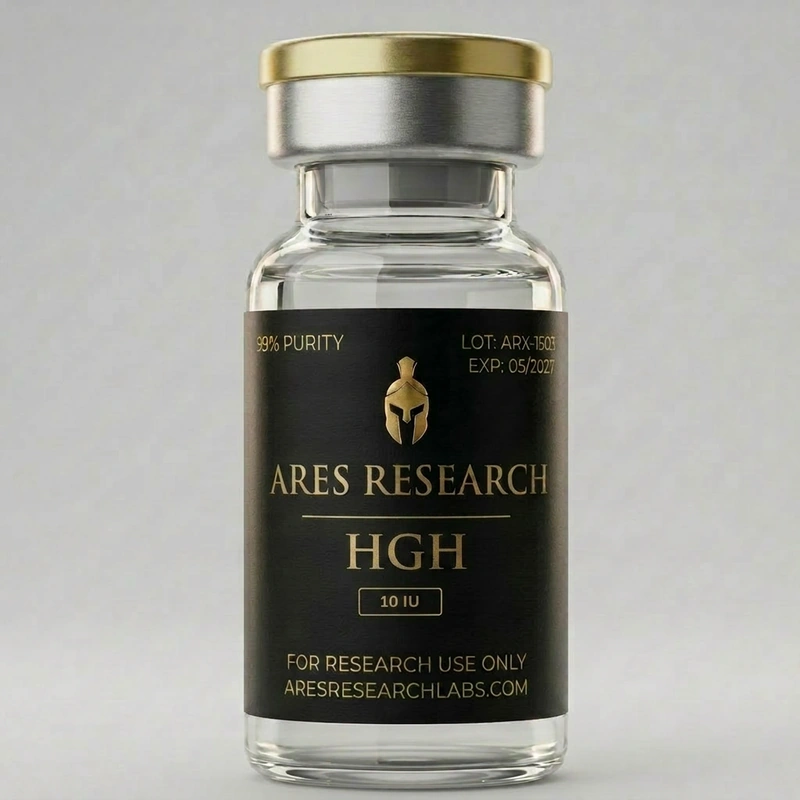
HGH supplied by Ares Research is recombinant somatropin (191 amino acid sequence) presented as a lyophilized powder in sealed vials, available in 10 IU through 36 IU sizes as single vials or 10-vial kits. Every unit is intended strictly for laboratory research use and is not a drug, supplement, or product for human or veterinary consumption.
Lyophilized vials are shipped with cold-chain packaging and should be transferred to refrigerated storage (2–8°C) on arrival. Unopened lyophilized material is generally stable under refrigeration for the period stated on the batch record; long-term holding is typically done at −20°C. Protect vials from light and avoid repeated temperature cycling, which is the most common cause of potency variance in growth hormone research material.
Reconstitution is performed with bacteriostatic water directed slowly against the vial wall rather than injected directly onto the cake. Somatropin is shear-sensitive: swirl gently until dissolved and never vortex or shake, as agitation drives aggregation and denaturation. Reconstituted solution should be clear and particle-free, held at 2–8°C, and discarded if cloudiness, precipitate, or fibrils appear. Our reconstitution calculator can be used to work out concentration per unit for a given vial size and diluent volume.
Each lot carries a printed batch ID that maps to a third-party certificate of analysis. Identity and purity are established by HPLC and mass spectrometry, with typical purity reported at ≥99%. Researchers can look the batch up in the public COA library, or request the full analytical packet for a specific lot before or after purchase, so on-hand material can be traced to its own test data rather than a generic brand-level claim.
Third-party purity testing available upon request.
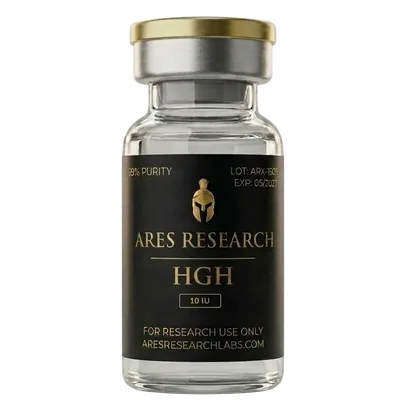
| Compound | Recombinant somatropin (HGH), 191 amino acid sequence |
|---|---|
| CAS number | 12629-01-5 |
| Molecular formula | C990H1528N262O300S7 |
| Molecular weight | ≈22,125 Da |
| Appearance | White lyophilized powder, sealed vial |
| Presentation | 10, 12, 15, 20, 24, 36 IU vials; 10-vial kits |
| Typical purity | ≥99% by HPLC, identity confirmed by MS |
| Reconstitution | Bacteriostatic water, added slowly down the vial wall; swirl, never shake |
| Storage (lyophilized) | 2–8°C refrigerated; −20°C for long-term holding, protect from light |
| Storage (reconstituted) | 2–8°C; discard if cloudy or particulate forms |
| Batch documentation | Third-party COA per lot, batch ID printed on vial |
| Intended use | Laboratory research use only — not for human or veterinary use |
For laboratory research use only. Not for human consumption, diagnosis, or treatment.
Recombinant human growth hormone is a 191-amino-acid single-chain polypeptide of approximately 22 kDa, stabilised by two intramolecular disulfide bridges. The 191aa sequence is identical to the dominant endogenous pituitary isoform, which is why it is used as the reference standard in growth-hormone research rather than the older 192-amino-acid (met-HGH) construct.
Material is supplied lyophilized in sealed vials with a documented batch identifier so that purity, identity, and reconstitution records can be tracked across a study. Assayed to a ≥99% purity standard with third-party analytical support available to qualifying research accounts.
In the published literature, growth hormone binds a preformed homodimeric GH receptor and drives rotational activation of the receptor subunits, recruiting JAK2 and phosphorylating STAT5. Secondary branches described in the same body of work include the MAPK/ERK and PI3K/Akt pathways. Hepatic STAT5 activity is the principal driver of IGF-1 transcription, which is why IGF-1 concentration is the standard downstream readout in GH-axis research models.
Because exogenous HGH bypasses hypothalamic-pituitary control, research comparisons with GHRH analogues and GHRPs focus on pulsatility and feedback intactness rather than absolute exposure — the distinction covered in the HGH vs peptide GH stimulation comparison.
Growth-hormone literature reports material in both mass (mg) and activity (IU) units. The conversion convention used across the somatropin literature is approximately 3 IU per 1 mg. Reproducible documentation records the vial mass, the diluent volume used, the resulting concentration per unit of volume, and the derived IU figure.
The reconstitution calculator performs those conversions for lab records. Figures are documentation aids, not protocol recommendations.
Lyophilized recombinant HGH is stable in its powdered form and is normally held refrigerated and protected from light, with long-term storage at -20 °C in stability studies. Reconstitution is typically performed with bacteriostatic water directed against the vial wall rather than injected into the cake, since growth hormone is sensitive to shear and foaming.
Reconstituted material is generally kept at 2–8 °C and not frozen, as freeze-thaw cycling is a documented source of aggregation and potency loss. Institutional SOPs take precedence over general reference information.
Batch-level analytics for growth hormone research material typically include HPLC purity, identity confirmation by mass spectrometry, and — where the protocol requires it — endotoxin and heavy-metal screening. Traceability matters because sequence variants, degradation products, and aggregate content can all confound receptor-level readouts.
Verified, non-placeholder batch records are published on the transparency page. Additional documentation is available on request to qualifying research accounts.
Growth hormone is one of the most extensively characterised endocrine proteins, with research spanning body-composition models, recovery and connective-tissue studies, and the somatopause and longevity literature that follows from the 1990 Rudman work. Ares Research publishes structured reference summaries of that literature rather than outcome claims.
Start with the HGH somatropin research overview or the growth hormone research hub.
All content on this page is reference material for licensed laboratory research. Nothing here is medical advice, a dosing protocol, or a claim of therapeutic benefit. Products are sold strictly for in-vitro and laboratory research use and are not for human or veterinary consumption.
Each HGH lot is validated at ≥99% purity by SDS-PAGE and HPLC, with a batch-specific COA available on the product page.
HGH is reconstituted with bacteriostatic water added slowly against the vial wall to avoid protein denaturation. Do not shake — swirl gently until fully dissolved.
Reconstituted HGH is typically stored at 2–8°C and remains stable for 14–21 days in most protocols. Follow your study SOP for exact limits.
Published growth hormone literature commonly reports both units. The conventional conversion used in the somatropin literature is approximately 3 IU per 1 mg of recombinant HGH. Researchers documenting protocols should record both the mass (mg) and the derived activity (IU) for each reconstituted vial, along with diluent volume, so results remain reproducible. This is reference information for laboratory documentation only and is not dosing guidance.
The 191aa designation refers to the 191-amino-acid sequence of recombinant human growth hormone (somatropin), which is identical in sequence to the endogenous 22 kDa GH isoform. Older recombinant material was produced as a 192-amino-acid (met-HGH) variant. Sequence identity matters in research models because it affects receptor binding behaviour and immunogenicity data in the published literature. Supplied for laboratory research use only — not for human or veterinary use.
Orders ship domestically from the United States. Lyophilized material is shipped in its stable powdered form, which tolerates normal transit conditions; the vial should be refrigerated on arrival and reconstituted only when required by the protocol. Tracking is issued automatically once a label is generated. All material is sold strictly for laboratory research use — not for human consumption.
HGH is the full 191-amino-acid recombinant protein and acts across the GH receptor and downstream IGF-1 axis. HGH Fragment 176-191 is a short C-terminal fragment studied primarily in metabolic and lipolysis research models and does not reproduce the full receptor signalling profile of the intact protein. They are studied for different research questions and are not interchangeable reference materials.
Each batch is produced to a ≥99% purity standard and supported by third-party analytical documentation. HPLC purity, identity confirmation, and — where applicable — endotoxin and heavy-metal testing may be provided on request to qualifying research accounts. Verified batch records that are not placeholders are published on the transparency page.
Lyophilized recombinant HGH is typically stored refrigerated and protected from light; long-term storage in the published stability literature is at -20 °C. After reconstitution with bacteriostatic water, material is generally kept at 2–8 °C and not frozen or agitated vigorously, since growth hormone is sensitive to shear and freeze-thaw cycling. Follow your institution's validated handling SOPs.
Reference primer on recombinant growth hormone — receptor signalling (JAK2/STAT5, MAPK, PI3K), pharmacokinetic characterisation, and the published literature base for somatropin in GH-axis research.
Exogenous HGH versus GHRH analogues and GHRPs — pulsatility, IGF-1 profiles, receptor sensitivity, and feedback intactness as described across the comparative research literature.
IU-to-mg conversion conventions, how physiological and supraphysiological ranges are defined in study models, and how dose-response data is reported in the published GH literature.
Review of documented mechanisms — lipolysis, IGF-1–mediated protein synthesis, and recovery markers — as examined across the published GH body-composition literature.
From the landmark 1990 Rudman study through current somatopause data, this review examines what the longevity research literature reports about GH-axis decline.
Batch drops, COA releases, restock alerts, and HGH-only pricing — delivered to your inbox.
No spam · Unsubscribe anytime · For research use only
Independent, documentation-first breakdowns of the vendors researchers most often ask about for this compound. COA verification, US shipping, and sourcing transparency, side by side.
Curated complements for this compound — researchers most often pair it with these.
Sign in with the account that placed your order to leave a verified review.
No public questions yet — be the first to ask.
All testing documentation and COA data are provided for laboratory research use only and are not intended to support human consumption, diagnostic, or therapeutic use.
Independently tested by In-House Verification. Verified and batch-tracked by Ares Research. Additional reports available upon request.
No fillers. No shortcuts. Only verified compounds.
Researchers often weigh HGH against these alternatives. Spec-by-spec breakdowns: