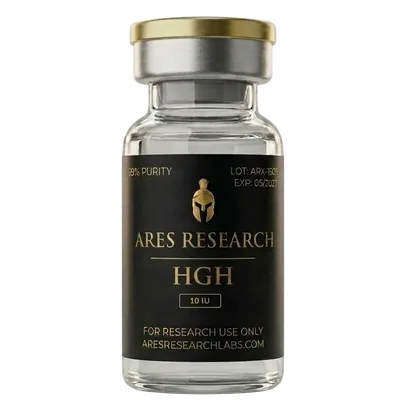
HGH Peptide Research Hub — Somatropin Studies, Dosing & Mechanisms
Recombinant human growth hormone (somatropin) is one of the most extensively studied endocrine compounds in the published literature. This hub aggregates Ares Research's HGH reference material — receptor signalling, dose-response, body composition, longevity, and head-to-head comparisons with peptide GH-axis modulators.
What this hub covers
- JAK2/STAT5, MAPK and PI3K receptor signalling
- IU/mg conversion and physiological vs supraphysiological dosing
- IGF-1 target ranges and pulsatility
- Body composition: lipolysis and protein synthesis literature
- Somatopause, longevity and the Rudman 1990 dataset
- HGH vs GHRH analogues (sermorelin, tesamorelin, CJC-1295) and GHRPs (ipamorelin)
HGH research articles
All research →Tesamorelin Half-Life & Pharmacokinetics
Research-only pharmacokinetic profile of Tesamorelin: serum half-life, Tmax, route comparisons, clearance and bioavailability — curated from published preclinical and clinical PK literature.
Read article →Sermorelin (GHRH 1-29) Half-Life & Pharmacokinetics
Research-only pharmacokinetic profile of sermorelin (GHRH 1-29): serum half-life, Tmax, route behaviour, clearance and bioavailability from the published PK literature.
Read article →CJC-1295 (with and without DAC) Half-Life & Pharmacokinetics
Research-only pharmacokinetic profile of CJC-1295: serum half-life, Tmax, route comparisons, clearance and bioavailability — curated from published preclinical and clinical PK literature.
Read article →Ipamorelin Half-Life & Pharmacokinetics
Research-only pharmacokinetic profile of Ipamorelin: serum half-life, Tmax, route comparisons, clearance and bioavailability — curated from published preclinical and clinical PK literature.
Read article →HGH vs CJC-1295 / Ipamorelin — Research Comparison (2026)
Recombinant HGH vs CJC-1295/Ipamorelin stack: exogenous vs endogenous GH release, pulsatility, safety profile and cost.
Read article →Tesamorelin vs Sermorelin — Research Comparison (2026)
Tesamorelin vs sermorelin compared: GHRH receptor activation, half-life, dosing, and visceral-fat vs general GH-axis research applications.
Read article →HGH (Somatropin) Safety Profile — Research Reference (2026)
HGH safety profile: edema, carpal tunnel, glucose intolerance, IGF-1 monitoring, and contraindications.
Read article →HGH (Somatropin) Research Overview
Recombinant human growth hormone (somatropin) is a 191-amino acid single-chain polypeptide identical to pituitary-derived GH — the definitive reference compound for GH axis research, with the most extensive clinical evidence base of any GH-related intervention and a fully characterised receptor signalling mechanism spanning JAK2/STAT5, MAPK, and PI3K pathways.
Read article →HGH (Somatropin) Benefits and Side Effects: A Research Guide
Comprehensive research guide on recombinant human growth hormone (somatropin): GH-receptor signalling, IGF-1 axis effects, body-composition and longevity literature, and the documented side-effect profile.
Read article →HGH and IGF-1: Understanding the Downstream Axis
Comprehensive research guide to the HGH/IGF-1 axis — hepatic IGF-1 production, IGFBPs 1–6, the ternary complex, PI3K/AKT/mTOR signalling, and the systemic vs local IGF-1 distinction.
Read article →HGH vs Peptide-Based GH Stimulation: A Research Comparison
A definitive research comparison of exogenous HGH (somatropin) versus peptide-based GH axis stimulation using GHRH analogues and GHRPs — covering pulsatility, physiological authenticity, IGF-1 profiles, receptor sensitivity, regulatory status, cost, and how to select the right approach for specific research applications.
Read article →HGH vs Tesamorelin — Research Comparison
Recombinant HGH (somatropin) vs Tesamorelin (GHRH analog) — side-by-side comparison of mechanism, IGF-1 induction, and visceral-adiposity research literature.
Read article →HGH vs IGF-1 LR3 — Research Comparison
Recombinant HGH (somatropin) vs IGF-1 LR3 (long-arginine-3 IGF-1) — side-by-side research comparison of upstream hormone vs downstream effector.
Read article →HGH Dosing Protocols in Research: Low vs High Dose Models
A comprehensive research guide to HGH dosing protocols — covering low-dose physiological replacement, intermediate research dosing, high-dose supraphysiological models, IGF-1 target ranges, dose-response relationships, timing considerations, and how dosing strategy affects body composition, metabolic, and safety endpoints across research contexts.
Read article →HGH & Body Composition: Lean Mass, Fat Loss & Recovery
Growth hormone occupies a central position in body composition regulation — stimulating lipolysis in adipose tissue, promoting protein synthesis in muscle, and driving IGF-1–mediated anabolic effects throughout the body. This article examines the documented mechanisms and clinical evidence base behind HGH's effects on lean mass, fat mass, and recovery.
Read article →HGH for Anti-Aging: What the Research Shows
Growth hormone production declines approximately 14% per decade after age 30 — a phenomenon known as somatopause. Decades of research have examined whether restoring GH to younger levels reverses age-associated physical decline. Here is what the evidence actually shows, from the landmark 1990 Rudman study through the most current clinical data.
Read article →Tesamorelin Benefits and Side Effects: A Research Guide
Published benefits, side effects, and comparisons for tesamorelin — the GHRH(1-44) analog with the strongest clinical evidence base for visceral-fat reduction.
Read article →Tesamorelin vs CJC-1295: GHRH Analog Research Comparison
Compare tesamorelin (FDA-approved GHRH analog) and CJC-1295 — pharmacokinetics, pulsatility, IGF-1 response, and published research findings.
Read article →Tesamorelin Dosing & Protocols — Research Reference
Reference compilation of tesamorelin reconstitution, daily dosing protocols, and visceral-adipose endpoint markers from published research.
Read article →CJC-1295 + Ipamorelin Stack Protocols — Research Reference
Reference compilation of CJC-1295 + Ipamorelin combined-administration protocols, scheduling, and GH-axis endpoint markers.
Read article →HGH Mechanism of Action — Research Reference
GH receptor binding, JAK2-STAT5 signalling, downstream hepatic IGF-1 generation, and direct vs IGF-1-mediated effects in growth hormone research.
Read article →HGH research FAQ
- What is HGH (somatropin) in a research context?
- Somatropin is a 191-amino-acid recombinant form of human growth hormone produced via recombinant DNA technology. In laboratory research it is studied for its interactions with the GH receptor and downstream JAK2/STAT5, MAPK and PI3K signalling cascades, primarily as a reference compound for endocrine and body-composition models.
- How do researchers convert HGH IU to mg?
- The standard conversion used across the published literature is 1 mg ≈ 3 IU of recombinant somatropin. A 10 IU vial therefore contains approximately 3.33 mg of active peptide. Always confirm against the supplier's certificate of analysis (COA) for batch-specific potency.
- What is the difference between HGH and peptide GH secretagogues?
- Exogenous HGH directly supplies somatropin, producing a sustained, non-pulsatile elevation in serum GH and IGF-1. Peptide secretagogues — GHRH analogues (sermorelin, tesamorelin, CJC-1295) and GHRPs (ipamorelin, hexarelin) — instead stimulate the pituitary to release endogenous GH, preserving physiological pulsatility and negative feedback. See the HGH vs Peptide GH Stimulation comparison for the full review.
- What IGF-1 ranges does the HGH research literature reference?
- Most published HGH protocols target age- and sex-adjusted IGF-1 within or modestly above the upper quartile of the normal reference range. Specific targets vary by study design; the HGH Dosing Protocols guide compiles the documented ranges by age cohort.
- How should HGH be stored and reconstituted for research?
- Lyophilized somatropin is typically stored at 2–8 °C protected from light. After reconstitution with bacteriostatic water, stability data supports refrigerated storage with use within the window described on the COA. Follow standard sterile technique and your lab's SOPs.
All content on this hub is provided strictly for laboratory research purposes. Compounds listed are not for human or veterinary consumption. See our research-use disclosure for full terms.