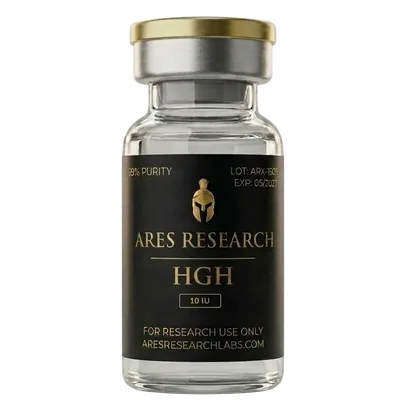
HGH vs Tesamorelin — Research Comparison
Recombinant HGH (somatropin) vs Tesamorelin (GHRH analog) — side-by-side comparison of mechanism, IGF-1 induction, and visceral-adiposity research literature.
HGH (somatropin) and tesamorelin sit on the same growth-hormone axis but enter it at different points. Somatropin is exogenous, recombinant human growth hormone — the hormone itself. Tesamorelin is a stabilised analogue of growth-hormone-releasing hormone (GHRH), one step upstream at the pituitary. This comparison summarises the published literature relevant to laboratory research.
At-a-glance comparison
| Attribute | HGH (Somatropin) | Tesamorelin | |---|---|---| | Class | Recombinant human growth hormone | GHRH analog | | Site of action | Hepatic + peripheral GH receptors | Pituitary somatotrophs (upstream) | | GH release pattern | Exogenous, non-pulsatile | Pulsatile (preserves GH-axis feedback) | | IGF-1 induction | Strong, dose-proportional | Moderate | | Reported half-life | ~3.5 hours subcutaneous | ~26 minutes (peptide), pulsatile effect lasts longer | | Cited research endpoint | Body composition, IGF-1, longevity | Visceral adipose tissue (HIV-associated lipodystrophy) | | Typical research dose | 1-4 IU/day | 2 mg/day |
Mechanism — exogenous hormone vs upstream secretagogue
Somatropin bypasses the pituitary entirely — it is the GH molecule itself, binding directly to hepatic and peripheral GH receptors to drive IGF-1 production and metabolic signalling. Tesamorelin works one step upstream: it binds pituitary GHRH receptors and stimulates endogenous GH release, preserving pulsatility and the natural negative-feedback loop with somatostatin.
Pharmacokinetics
Somatropin has a subcutaneous half-life of approximately 3.5 hours but produces sustained elevation of IGF-1 (which has a much longer half-life). Tesamorelin's plasma half-life is approximately 26 minutes, but its pulsatile downstream effect on endogenous GH release persists for hours.
Published research highlights
Somatropin is one of the most-extensively studied endocrine compounds in published literature — body composition, IGF-1 induction, and the foundational Rudman 1990 dataset all derive from somatropin research. Tesamorelin's most-cited research is in HIV-associated visceral lipodystrophy, where it produced approximately 15-18% reductions in visceral adipose tissue across the published Phase 3 trials.
Where they overlap, where they don't
Overlap: both raise IGF-1, both produce lipolysis and improved body composition in published research. Divergence: somatropin's IGF-1 induction is markedly stronger and dose-proportional, while tesamorelin's is bounded by endogenous feedback; somatropin's effects are direct and reproducible across cell models, while tesamorelin requires intact pituitary function.
Choosing one for a research protocol
For research requiring direct GH-receptor stimulation, strong IGF-1 induction, or comparison to the foundational somatropin literature, somatropin is the more-referenced compound. For research into upstream GHRH biology, pulsatile GH release, or visceral-adipose-tissue endpoints with preserved feedback, tesamorelin is the more appropriate reference.
Frequently asked research questions
Is tesamorelin a substitute for HGH?
Mechanistically they are different — tesamorelin requires intact pituitary function and produces a smaller IGF-1 response than equivalent direct somatropin dosing. They are studied for different research endpoints rather than as substitutes.
Why is pulsatility cited as important?
Endogenous GH release is naturally pulsatile, and the GH-axis feedback loop (somatostatin) responds to that pulsatility. Tesamorelin preserves both; exogenous somatropin replaces both with continuous receptor exposure, which is a distinct pharmacological profile in the literature.
How does the IGF-1 response compare?
Direct somatropin produces a much larger, dose-proportional rise in IGF-1 because it bypasses the pituitary entirely. Tesamorelin's IGF-1 rise is bounded by endogenous negative feedback at the pituitary.
Can the two be combined in a research protocol?
Combining direct somatropin with a pituitary-level GHRH analog like tesamorelin is mechanistically redundant — exogenous somatropin suppresses endogenous GH release via somatostatin feedback. Published research models use one or the other.
Related research
- HGH research hub → /research/hubs/hgh
- Tesamorelin research hub → /research/hubs/tesamorelin
- CJC-1295 vs Ipamorelin → /research/cjc-1295-vs-ipamorelin-research-comparison
- HGH vs IGF-1 LR3 → /research/hgh-vs-igf-1-lr3-research-comparison
Research use only. All content on this page is provided for in-vitro and laboratory research purposes. No statements are intended for, and nothing on this page should be construed as, medical advice or a recommendation for human consumption.
Running the numbers for a protocol? Use the research calculators to convert mg, mL, and syringe units.
Related Research Articles
Ipamorelin vs MK-677 — Research Comparison (2026)
Ipamorelin (peptide GHRP) vs MK-677/ibutamoren (oral ghrelin mimetic): selectivity, route, half-life and IGF-1 effects.
Related Research Materials
Parent Research Hubs
Recombinant human growth hormone (somatropin) is one of the most extensively studied endocrine compounds in the published literature. This hub aggregates Ares Research's HGH reference material — receptor signalling, dose-response, body composition, longevity, and head-to-head comparisons with peptide GH-axis modulators.
Explore hub →Tesamorelin is a synthetic 44-amino-acid analog of growth hormone releasing hormone (GHRH) with a stabilising trans-3-hexenoyl modification at the N-terminus. It is one of the most thoroughly characterised GHRH analogues in the clinical literature, particularly for studies of visceral adipose tissue and the GH/IGF-1 axis.
Explore hub →Neutral, moderated research discussion. Laboratory use only.
More compound guides, hubs, and educational research materials.