
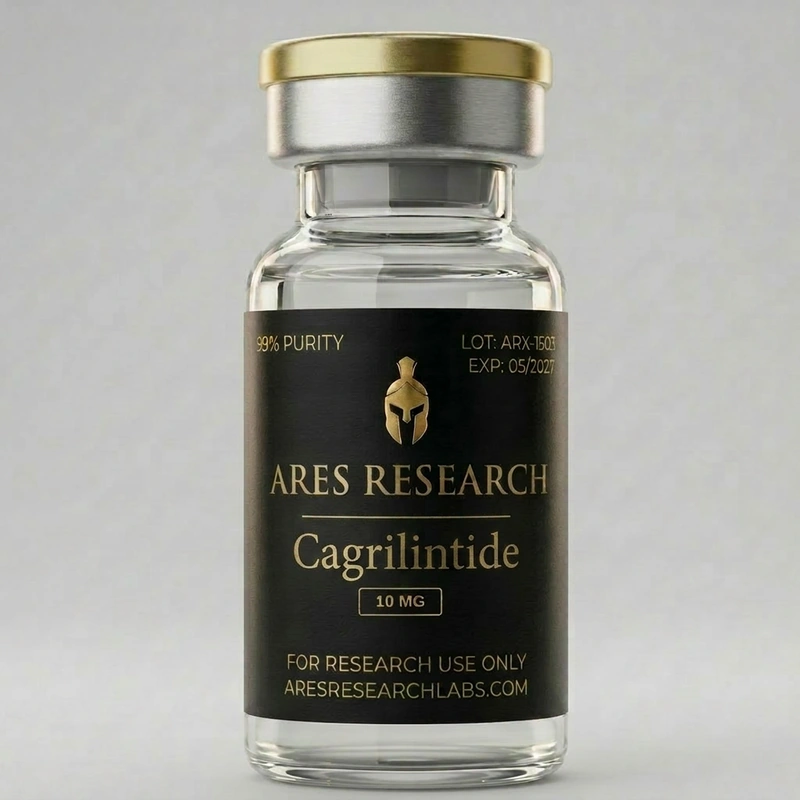
Cagrilintide
Documentation & standards
- How to Read a Peptide Certificate of Analysis (COA)
- Peptide Storage and Handling: Temperature, Light and Stability
- Research-Use-Only Compliance: What the Label Obligates
Long-acting synthetic amylin analog for controlled amylin-receptor and metabolic-signalling research.
Mix and match any items — discount applies automatically at checkout.
Reminder email when it's time to reorder. No card on file. Cancel anytime from your account — or email support@aresresearchlab.com.
Earn 94 loyalty points on this purchase · 100 pts = $5 off
Create a Research Account to unlock full batch data, COAs, and priority releases.
Intended strictly for controlled laboratory receptor and pathway research.
Cagrilintide and amylin-receptor research
Cagrilintide is a long-acting synthetic amylin analog supplied as laboratory reference material. Research centers on amylin-receptor complexes formed from the calcitonin receptor and receptor-activity-modifying proteins.
Controlled studies can examine receptor binding, RAMP-dependent receptor composition, ligand-response relationships, and downstream metabolic-signalling measurements within defined experimental systems.
The dual-component material is listed separately as the Cagrilintide + Semaglutide Blend.
Cagrilintide testing and batch documentation
A standalone Cagrilintide testing record is logged in the batch system, but no report PDF or laboratory verification URL is currently attached. It is therefore not presented as a directly viewable independent report. Match the identifier on the received material to the public lookup and review the transparency standards for documentation context.
Cagrilintide research material specifications
| Compound | Cagrilintide |
|---|---|
| Class | Long-acting synthetic amylin analog |
| Research focus | Amylin-receptor complexes, calcitonin receptor, and RAMP-associated signalling |
| Purity specification | ≥99% |
| Physical form | Lyophilized powder in a sealed glass vial |
| Available vial sizes | 5 mg and 10 mg |
| Testing | A testing record is logged; no directly viewable PDF or laboratory verification URL is currently attached |
| Storage | Refrigerated, dry, and protected from light; follow batch documentation |
| Intended scope | Controlled laboratory research only — not for human or veterinary use |
Amylin analog development reference
Kruse T et al., “Development of Cagrilintide, a Long-Acting Amylin Analogue,” Journal of Medicinal Chemistry (2021), PMID 34288673. Listed for compound-development and receptor-research context only.
Cagrilintide research questions
+What is Cagrilintide?
Cagrilintide is a long-acting synthetic amylin analog supplied as laboratory research material for controlled amylin-receptor and metabolic-signalling studies.
+Which receptor system is central to Cagrilintide research?
Cagrilintide research centers on amylin-receptor complexes formed by the calcitonin receptor and receptor-activity-modifying proteins, including RAMP1, RAMP2, and RAMP3.
+How does Cagrilintide differ from the Cagrilintide + Semaglutide blend?
The standalone material isolates amylin-analog signalling. The blend combines Cagrilintide with a GLP-1 analog so laboratories can examine two receptor pathways in one material system.
+Is a directly viewable Cagrilintide report available?
A testing record is logged for standalone Cagrilintide, but no report PDF or laboratory verification URL is currently attached. Use the public batch lookup to confirm documentation available for the specific material received.
+What purity specification applies to Cagrilintide?
The listed purity specification is ≥99%. A specification is not a batch result; researchers should use the batch identifier to check the documentation attached to their material.
+What formats are available?
Standalone Cagrilintide is offered as sealed lyophilized research material in 5 mg and 10 mg vial sizes. Current offers appear on this page.
Read the Cagrilintide research
A laboratory research overview of Cagrilintide identity, long-acting amylin-analog design, receptor complexes, and analytical study considerations.
Read article →A receptor-level guide to Cagrilintide, calcitonin-receptor and RAMP complexes, ligand-response measurements, and experimental controls.
Read article →A laboratory comparison of amylin-receptor and GLP-1-receptor signaling, with controls for combined CagriSema research designs.
Read article →Researcher Reviews
Sign in with the account that placed your order to leave a verified review.
Ask the Lab
No public questions yet — be the first to ask.