How to Read a Peptide Certificate of Analysis (COA)
A Certificate of Analysis is the single document that connects a purity claim to a physical lot. Most disputes in the research-chemical market come down to a COA that is undated, unattributed, or attached to a lot number that no longer exists. This page walks the document field by field so you can audit one in under two minutes.
What a COA must contain
A usable Certificate of Analysis identifies the material, the lot, the laboratory, and the date. Anything missing one of those four is marketing collateral, not analytical documentation.
- Compound name and sequence or molecular formula
- Lot / batch identifier that matches the vial label
- Analysis date and the name of the testing laboratory
- HPLC chromatogram with an integrated purity percentage
- Mass-spectrometry result confirming expected molecular weight
- Peptide content or water/counter-ion content where applicable
Purity versus peptide content
HPLC purity describes what fraction of the peptide-related material in the sample is the target sequence. Peptide content describes how much of the vial's mass is peptide at all, with the remainder being residual water, acetate or TFA counter-ions.
A vial can be 99% pure by HPLC and still be 80% peptide by mass. Reconstitution math should be based on the labelled peptide mass; if you are converting mg to mL to syringe units, run it through the reconstitution calculator rather than estimating.
Matching a COA to the vial in front of you
The lot number printed on the vial is the join key. Ares publishes lot-level records so a batch can be pulled before or after purchase — start at the COA batch lookup, and cross-check the published records on the transparency page.
Two-minute COA audit
- 01Does the lot on the document match the lot on the vial?
- 02Is the analysis date within the material's stated shelf life?
- 03Is the testing laboratory named and independently contactable?
- 04Is there an actual chromatogram, not just a typed percentage?
- 05Does the MS result match the expected molecular weight?
Verify a lot yourself
Run the numbers
Vial mass + diluent volume → mg/mL, mcg/mL, and mcg per syringe unit.
Any vial, any diluent volume, any target amount → concentration, syringe units, doses per vial.
All twelve tools are listed on the research calculator hub.
Compounds documented to this standard
Research-grade peptide commonly studied in cellular and tissue research models.
Synthetic GHRH analog used in endocrine signaling research.
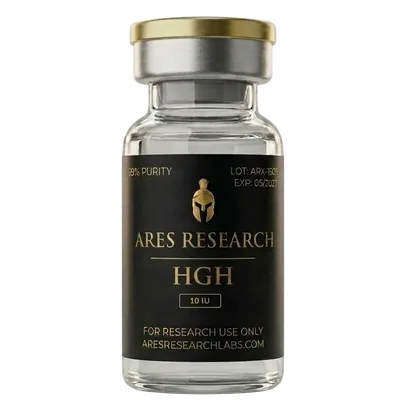
HGH (somatropin) — recombinant 191aa human growth hormone, lyophilized and COA-tested to a ≥99% purity standard, studied in endocrine and GH–IGF-1 signaling research. Laboratory research use only.
Copper-binding tripeptide examined in extracellular matrix research.
Questions
- What does 99% purity on a peptide COA mean?
- It means that 99% of the peptide-related material detected by HPLC at the stated wavelength is the target sequence. It is not a statement about total vial mass, which is covered by peptide content.
- Should a COA be lot-specific?
- Yes. A COA that cannot be tied to a specific lot number cannot be verified against the vial you received, which makes the purity figure unauditable.
Continue in this cluster
Ares Research Lab supplies material for laboratory research use only. Not for human consumption, diagnosis or treatment. Analytical documentation describes purity and identity of a chemical lot and is not evidence of clinical safety.