Peptide Storage and Handling: Temperature, Light and Stability
Analytical purity describes a lot at a point in time. What happens afterwards is determined by storage. Lyophilised peptide is comparatively robust; once reconstituted, the clock starts and temperature becomes the dominant variable.
Lyophilised versus reconstituted
In lyophilised form, most research peptides tolerate refrigerated storage well and freezer storage better, because the absence of water suppresses hydrolysis. In solution, degradation pathways open up: hydrolysis, oxidation of methionine and cysteine residues, and aggregation.
Working out how much diluent to add — and therefore how long a vial will realistically last — is a volume problem before it is a stability problem. The bacteriostatic water calculator and reconstitution calculator handle that arithmetic.
Light, heat and freeze-thaw
Ambient light degrades photosensitive sequences, and repeated freeze-thaw cycles mechanically stress peptides in solution. Aliquoting after reconstitution avoids repeatedly warming an entire vial to withdraw a fraction of it.
Shipping excursions
Transit is the least controlled part of the chain. Heat-sensitive compounds should ship insulated with cold packs, and material that arrives warm should be assessed rather than assumed intact. Ares dispatches temperature-sensitive material with insulated packaging from a domestic facility.
Storage quick reference
- 01Keep lyophilised vials cold, dark and dry until use
- 02Reconstitute with bacteriostatic water where multi-withdrawal is intended
- 03Aliquot rather than repeatedly freeze-thawing one vial
- 04Label aliquots with compound, concentration and date
- 05Record any transit temperature excursion against the lot
Verify a lot yourself
Run the numbers
Compare diluent volumes before you mix — see how each one changes the syringe reading.
Vial mass + diluent volume → mg/mL, mcg/mL, and mcg per syringe unit.
All twelve tools are listed on the research calculator hub.
Compounds documented to this standard
Research-grade peptide commonly studied in cellular and tissue research models.
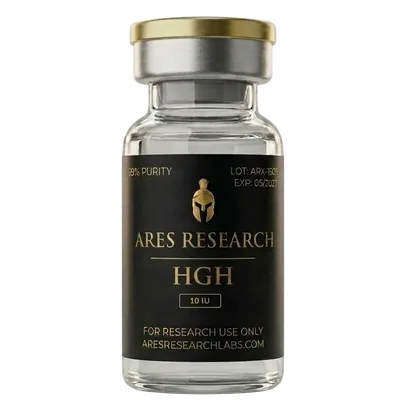
HGH (somatropin) — recombinant 191aa human growth hormone, lyophilized and COA-tested to a ≥99% purity standard, studied in endocrine and GH–IGF-1 signaling research. Laboratory research use only.
Advanced metabolic research compound. Studied in metabolic and energy pathway models. High-purity research-grade material.
Coenzyme studied in cellular energetics and longevity research.
Questions
- How long is a reconstituted peptide stable?
- Stability in solution is sequence-dependent and temperature-dependent. Refrigerated storage in bacteriostatic water is the common laboratory practice, with shorter working windows for sequences prone to oxidation.
- Does a warm shipment ruin lyophilised peptide?
- Not necessarily — lyophilised material is more heat-tolerant than material in solution — but any excursion should be recorded against the lot rather than ignored.
Continue in this cluster
Ares Research Lab supplies material for laboratory research use only. Not for human consumption, diagnosis or treatment. Analytical documentation describes purity and identity of a chemical lot and is not evidence of clinical safety.