L-Carnitine
Documentation & standards
- How to Read a Peptide Certificate of Analysis (COA)
- Peptide Storage and Handling: Temperature, Light and Stability
- Research-Use-Only Compliance: What the Label Obligates

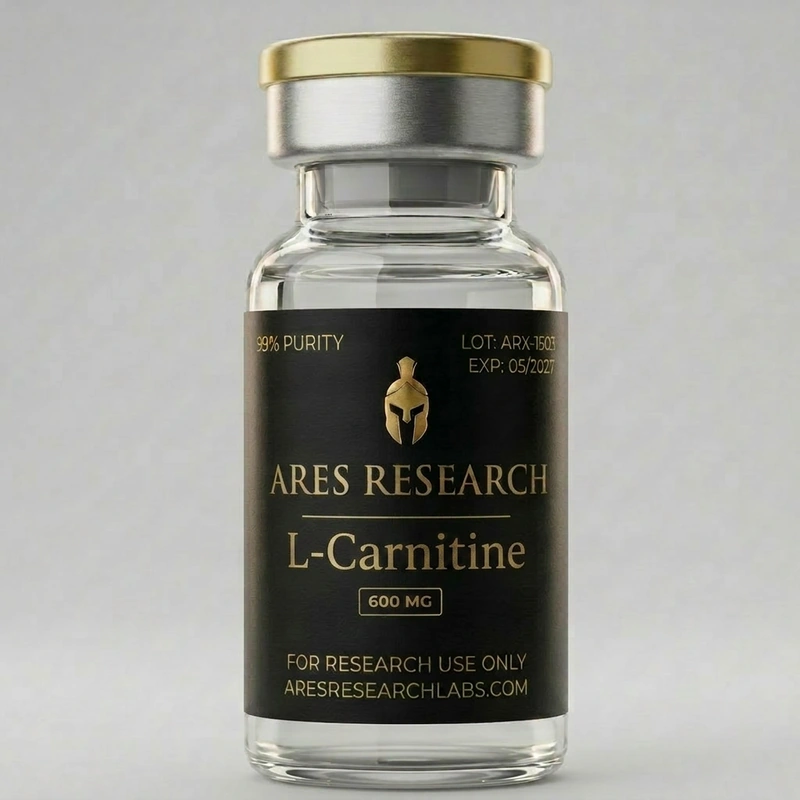
Naturally occurring amino-acid-derived quaternary ammonium compound studied in fatty-acid transport, cellular-energy, and mitochondrial-metabolism research. 600 mg/mL · 10 mL research solution (6,000 mg total).
Mix and match any items — discount applies automatically at checkout.
Earn 54 loyalty points on this purchase · 100 pts = $5 off
Create a Research Account to unlock full batch data, COAs, and priority releases.
Intended strictly for controlled laboratory receptor and pathway research.
What is L-Carnitine?
L-Carnitine is a naturally occurring amino-acid-derived quaternary ammonium compound, not a peptide. It is studied in controlled systems for its central role in long-chain fatty-acid transport into mitochondria and for cellular-energy, fatty-acid-oxidation, and mitochondrial-metabolism endpoints.
The carnitine shuttle uses carnitine palmitoyltransferase 1 (CPT1), carnitine-acylcarnitine translocase (CACT), and carnitine palmitoyltransferase 2 (CPT2) to transfer fatty-acid groups across the inner mitochondrial membrane. Experimental readouts remain specific to the model, conditions, and measurement method.
Plain L-Carnitine is distinct from Acetyl-L-Carnitine (ALCAR), its acetylated derivative. It is also distinct from Lipo-C, a separate methionine, inositol, and choline research blend that does not list carnitine as a component.
L-Carnitine COA and batch verification
No L-Carnitine-specific analytical report is currently attached to this listing, so this page does not cite or imply an individual analytical result. Researchers can match an identifier from a received unit through the public batch lookup and review the published verification standards.
L-Carnitine research solution specifications
| Compound | L-Carnitine |
|---|---|
| Compound type | Naturally occurring amino-acid-derived quaternary ammonium compound |
| Research focus | Fatty-acid transport, fatty-acid oxidation, cellular energy, and mitochondrial metabolism |
| Pathway context | Carnitine shuttle: CPT1, CACT, and CPT2 |
| Physical form | Research solution in a sealed 10 mL vial |
| Concentration | 600 mg/mL |
| Total content | 6,000 mg per vial |
| Attached report | No L-Carnitine-specific analytical report currently attached |
Fatty-acid transport and mitochondrial research
Longo N et al., “Carnitine transport and fatty acid oxidation” (2016), PMID 26828774.
Choi J et al., “Carnitine palmitoyltransferase 1 facilitates fatty acid oxidation in a non-cell-autonomous manner” (2024), PMID 39671290. References are listed for pathway and model-system context only.
L-Carnitine research questions
+What is L-Carnitine?
L-Carnitine is a naturally occurring amino-acid-derived quaternary ammonium compound. Laboratory research examines its role in transporting long-chain fatty-acid groups into mitochondria for oxidation and cellular-energy metabolism.
+Is L-Carnitine a peptide?
No. L-Carnitine is an amino-acid-derived small molecule, not a peptide. This listing is a research solution rather than a lyophilized peptide product.
+What is the carnitine shuttle?
The carnitine shuttle is the CPT1, carnitine-acylcarnitine translocase (CACT), and CPT2 transport system that moves long-chain fatty-acid groups across the inner mitochondrial membrane for beta-oxidation studies.
+Which L-Carnitine research endpoints are commonly examined?
Research commonly measures fatty-acid transport, acylcarnitine formation, mitochondrial beta-oxidation, ATP-linked cellular-energy metabolism, and related pathway readouts in controlled systems.
+Is L-Carnitine the same as Acetyl-L-Carnitine (ALCAR)?
No. Acetyl-L-Carnitine is an acetylated carnitine derivative with a distinct chemical form and research profile. The catalog product on this page is plain L-Carnitine, not ALCAR.
+Is L-Carnitine the same as Lipo-C?
No. This listing is plain L-Carnitine. The separate Lipo-C catalog product is a methionine, inositol, and choline research blend and does not list carnitine as a component.
+What are the L-Carnitine solution specifications?
The current catalog offer is a 10 mL research solution at 600 mg/mL, providing 6,000 mg total L-Carnitine per vial.
+Is an L-Carnitine analytical report attached to this listing?
No L-Carnitine-specific analytical report is currently attached. Researchers should use the public batch lookup to check documentation associated with a received unit and review the published verification standards.
Read the L-Carnitine research
Researcher Reviews
Sign in with the account that placed your order to leave a verified review.
Ask the Lab
No public questions yet — be the first to ask.