Sermorelin
Documentation & standards
- How to Read a Peptide Certificate of Analysis (COA)
- Peptide Storage and Handling: Temperature, Light and Stability
- Research-Use-Only Compliance: What the Label Obligates
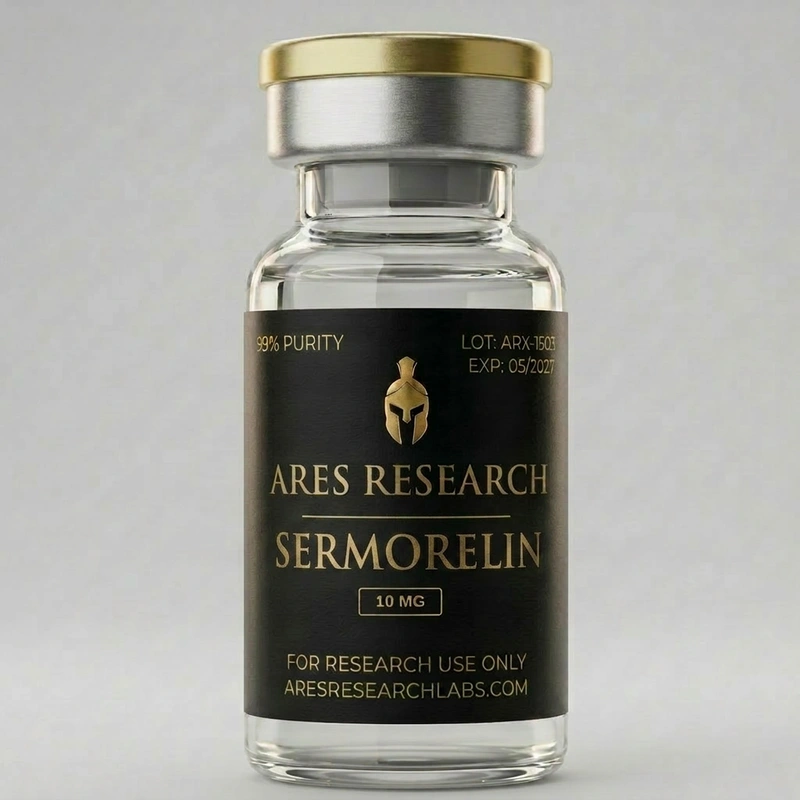
Synthetic GHRH(1-29) fragment — the shortest GHRH sequence retaining receptor activity — studied at the pituitary GHRH receptor in endogenous growth hormone secretion research models.
Mix and match any items — discount applies automatically at checkout.
Reminder email when it's time to reorder. No card on file. Cancel anytime from your account — or email support@aresresearchlab.com.
Earn 34 loyalty points on this purchase · 100 pts = $5 off
Create a Research Account to unlock full batch data, COAs, and priority releases.
Intended strictly for controlled laboratory receptor and pathway research.
What is sermorelin (GHRH 1-29)?
Sermorelin is a synthetic peptide corresponding to GHRH(1-29), the first 29 residues of growth hormone releasing hormone. Published literature describes it as the shortest GHRH fragment retaining receptor activity, which is why it is widely referenced as a structural proxy for native GHRH in laboratory work.
Research with sermorelin examines engagement of the pituitary GHRH receptor and the resulting endogenous growth hormone secretion profile — pulse characteristics, clearance kinetics, and downstream IGF-1 measurements — in defined experimental systems. It is related to, but structurally distinct from, mod-GRF 1-29 and the CJC-1295 DAC and no-DAC variants, which add modifications that alter circulating exposure. This page describes the compound and those studied endpoints only.
Sermorelin COA and batch verification
A Janoshik Analytical report dated June 2026 for Sermorelin 5 mg is on file and displayed with this listing. Verification for research material supplied under this catalog follows the documented process: match the identifier on the received unit through the public batch lookup, and review the published verification standards before use.
Sermorelin research material specifications
| Compound | Sermorelin (sermorelin acetate) |
|---|---|
| Sequence | GHRH(1-29) — 29-amino-acid fragment of growth hormone releasing hormone |
| Class | GHRH analog research peptide |
| Pathway studied | Pituitary GHRH receptor and endogenous growth hormone secretion |
| Research focus | GH secretion profile, pulse characteristics, and downstream IGF-1 measurements |
| Related structures | Distinct from mod-GRF 1-29 and CJC-1295 (DAC and no-DAC) variants |
| Purity specification | ≥99% |
| Physical form | Lyophilized powder in a sealed glass vial |
| Available vial sizes | 2 mg, 5 mg, 10 mg |
| Attached report | Sermorelin 5 mg — Janoshik Analytical (June 2026) |
| Storage | Refrigerated, dry, and protected from light; follow batch documentation |
GHRH analog research context
Memdouh S et al., “Advances in the detection of growth hormone releasing hormone synthetic analogs” (2021), PMID 34665524. Listed for GHRH analog analytical context only.
Sermorelin research questions
+What is sermorelin?
Sermorelin is a synthetic peptide corresponding to GHRH(1-29) — the first 29 residues of growth hormone releasing hormone, described in the literature as the shortest fragment that retains GHRH receptor activity. It is supplied here as laboratory research material.
+Why is sermorelin described as a GHRH analog?
Its sequence reproduces the receptor-binding region of native GHRH, so published work describes it as a GHRH analog studied at the pituitary GHRH receptor in defined experimental systems.
+Which pathway is studied in sermorelin research?
Published research examines GHRH receptor engagement at the anterior pituitary and the resulting endogenous growth hormone secretion profile, including pulse characteristics and downstream IGF-1 measurements in laboratory and animal models.
+How does sermorelin differ from CJC-1295 and mod-GRF 1-29?
All three are built on the GHRH(1-29) region, but sermorelin is the unmodified fragment. Mod-GRF 1-29 carries substitutions that resist DPP-IV cleavage, and CJC-1295 with DAC adds an albumin-binding group that extends circulating exposure. Sermorelin is therefore studied as the closest structural proxy to native GHRH.
+Is a sermorelin analytical report available?
Yes. A Janoshik Analytical report (June 2026) for Sermorelin 5 mg is on file and displayed with this listing. Researchers should still match the identifier on the received unit through the public batch lookup and review the verification standards page.
+Which sermorelin formats are offered?
Sermorelin is supplied as sealed lyophilized research material in 2 mg, 5 mg, and 10 mg vials. Current offers appear on this page.
+What is the listed purity specification?
The catalog specification is ≥99%. A specification is not the same as a batch result, so documentation associated with the received unit should be reviewed separately.
Read the Sermorelin research
Sermorelin (GHRH 1-29 NH2) is a synthetic 29-amino-acid peptide matching the N-terminal active fragment of growth hormone releasing hormone — the reference GHRH analog in published receptor-signaling research.
Read article →How sermorelin (GHRH 1-29) engages the pituitary GHRH receptor: Gs/cAMP/PKA signaling, pulse structure, feedback architecture, and comparison to modified GHRH analogs.
Read article →Research-only pharmacokinetic profile of sermorelin (GHRH 1-29): serum half-life, Tmax, route behaviour, clearance and bioavailability from the published PK literature.
Read article →Researcher Reviews
Sign in with the account that placed your order to leave a verified review.
Ask the Lab
No public questions yet — be the first to ask.
Independent Certificate of Analysis
Independently tested by Janoshik Analytical. Verified and batch-tracked by Ares Research. Additional reports available upon request.
No fillers. No shortcuts. Only verified compounds.