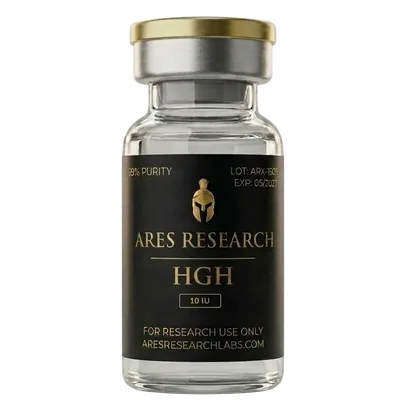
HGH for Anti-Aging: What the Research Shows
Growth hormone production declines approximately 14% per decade after age 30 — a phenomenon known as somatopause. Decades of research have examined whether restoring GH to younger levels reverses age-associated physical decline. Here is what the evidence actually shows, from the landmark 1990 Rudman study through the most current clinical data.
Somatopause: The Age-Related Decline in GH/IGF-1
The term "somatopause" describes the progressive, age-associated decline in GH secretion that begins in the third decade of life and continues throughout adulthood. Unlike menopause — a discrete hormonal transition — somatopause is a gradual, continuous process. Mean 24-hour GH secretion decreases approximately 14% per decade after age 30. By age 60, average daily GH output is approximately 25% of peak levels at age 20. IGF-1 — the primary downstream mediator of GH's anabolic effects, produced in the liver in response to GH — declines in parallel, falling from peak levels of approximately 300–400 ng/mL in young adults to 100–150 ng/mL by the seventh decade.
This hormonal decline correlates temporally with a constellation of body composition changes characteristic of aging: progressive increase in fat mass (particularly visceral adiposity), decrease in lean muscle mass (sarcopenia), reduction in bone mineral density, decreased skin thickness and elasticity, and impaired exercise capacity. The co-occurrence of GH/IGF-1 decline and these physical changes formed the basis of the hypothesis that restoring GH to youthful levels might reverse or attenuate these aging changes.
14%GH Decline Per Decade After 30 75%GH Lost by Age 60 vs Age 20 1990Rudman Landmark Study Published
The Rudman Study: The Paper That Started a Movement
Landmark Study — New England Journal of Medicine, 1990 Rudman D, et al. "Effects of Human Growth Hormone in Men over 60 Years Old" Daniel Rudman and colleagues randomised 21 healthy men aged 61–81 with low IGF-1 levels (<350 U/L) to receive subcutaneous GH three times weekly or no treatment for 6 months. The treated group showed: lean body mass increased by 8.8%; fat mass decreased by 14.4%; skin thickness increased by 7.1%; and lumbar vertebral bone density increased by 1.6% — all statistically significant versus the untreated group. Rudman famously described these changes as equivalent to reversing 10–20 years of aging in body composition. The paper was published in the New England Journal of Medicine and immediately captured global public attention, generating enormous demand for GH as an anti-aging intervention.
The Rudman study was groundbreaking but also limited in ways that were not immediately appreciated by the popular press. It enrolled only 21 men, had no placebo control (the comparison group received no injections at all, introducing potential placebo effects in subjective endpoints), lasted only 6 months, and did not measure functional outcomes, quality of life, or long-term health. The body composition changes — while real and statistically significant — were modest in absolute terms and did not translate to documented improvements in strength, physical function, or longevity in the study period.
What Subsequent Research Showed
Following the Rudman study, numerous controlled trials evaluated GH in aging adults — most with more rigorous designs including placebo controls, blinding, and longer duration. The aggregate findings from this literature, synthesised in multiple systematic reviews and meta-analyses, present a more nuanced picture than the initial excitement suggested.
Body Composition: Consistent but Modest Benefits
The most consistently replicated finding across GH aging trials is improvement in body composition: meta-analyses confirm that GH administration in older adults produces statistically significant increases in lean body mass (approximately 2 kg mean increase) and reductions in fat mass (approximately 2 kg mean decrease) across the studies. These body composition changes are real and repeatable. However, the lean mass increase is substantially attributable to fluid retention (GH increases sodium and water retention) rather than muscle protein accretion, and the changes in fat mass, while genuine, are modest compared to what is achievable through resistance exercise and caloric adjustment.
Muscle Strength and Physical Function: Largely Disappointing
Despite measurable increases in lean body mass, GH trials in aging adults have generally not demonstrated significant improvements in muscle strength or physical functional capacity. A systematic review by Blackman et al. and the consensus statement from the 2011 Growth Hormone Research Society found that GH-induced body composition changes in aging do not reliably translate to improved strength, gait speed, stair climbing, or activities of daily living. This dissociation between lean mass gain and functional strength improvement is a critical finding — it suggests that much of the "lean mass" increase from GH represents fluid and connective tissue rather than contractile muscle fibre hypertrophy.
Bone Density: Modest and Delayed
Bone mineral density (BMD) improvements with GH in aging adults have been documented in some long-term trials (12–24 months) but are modest (1–3% above placebo) and emerge more slowly than body composition changes. The mechanism — GH/IGF-1 stimulation of osteoblast activity and bone remodelling — is biologically sound, but the clinical significance of 1–3% BMD improvement in terms of fracture risk reduction remains uncertain. A 2-year withdrawal phase typically observed in these trials shows partial loss of BMD gains after stopping GH.
- Outcome Domain: Lean Body Mass — GH Effect in Aging Research: Consistent increase — Effect Size: ~2 kg mean — Clinical Significance: Moderate — partly fluid retention
- Outcome Domain: Fat Mass — GH Effect in Aging Research: Consistent decrease — Effect Size: ~2 kg mean — Clinical Significance: Moderate — real but modest
- Outcome Domain: Muscle Strength — GH Effect in Aging Research: Inconsistent; often not significant — Effect Size: Small–none — Clinical Significance: Low — poor translation from mass to function
- Outcome Domain: Bone Mineral Density — GH Effect in Aging Research: Modest increase (long-term) — Effect Size: ~1–3% — Clinical Significance: Low–moderate
- Outcome Domain: Skin Thickness — GH Effect in Aging Research: Consistent increase — Effect Size: ~7–10% — Clinical Significance: Cosmetic relevance
- Outcome Domain: Exercise Capacity — GH Effect in Aging Research: Inconsistent; modest in some studies — Effect Size: Small — Clinical Significance: Low
- Outcome Domain: Quality of Life — GH Effect in Aging Research: Inconsistent; subjective improvement in some — Effect Size: Variable — Clinical Significance: Uncertain
- Outcome Domain: Longevity — GH Effect in Aging Research: No human longevity trial data — Effect Size: Unknown — Clinical Significance: Unknown
The Adverse Effect Problem: Why "More is Not Better"
The adverse effect profile of GH in aging adults — particularly at supraphysiological doses — significantly constrains its clinical utility. The most common adverse effects documented in aging trials include: peripheral oedema (fluid retention) in 20–40% of subjects, arthralgias and joint pain in 15–30%, carpal tunnel syndrome in 10–20%, myalgias, and worsening of glucose tolerance/insulin resistance (GH is a counter-regulatory hormone to insulin). These adverse effects are dose-dependent and substantially more frequent in older adults than in GH-deficient patients receiving replacement doses.
The insulin resistance concern is particularly significant in aging populations who already have increased metabolic risk: GH at supraphysiological doses suppresses insulin signalling through SOCS-mediated inhibition, potentially accelerating progression toward type 2 diabetes. Several studies have documented new-onset glucose intolerance or frank diabetes in previously normoglycaemic elderly subjects receiving GH.
The IGF-1 and Cancer Question
One of the most important and unresolved questions in GH anti-aging research is the relationship between elevated IGF-1 — produced in response to exogenous GH — and cancer risk. IGF-1 is a potent mitogen that promotes cell proliferation and survival across multiple tissue types. Epidemiological studies have documented associations between elevated circulating IGF-1 and increased risk of breast, prostate, colorectal, and lung cancers, though causality remains debated.
Counterintuitively, extreme IGF-1 deficiency (Laron syndrome) appears protective against cancer — providing the strongest biological evidence that the IGF-1 signalling axis influences cancer risk. The implication for GH anti-aging research is that elevating IGF-1 from age-associated low levels to supraphysiological ranges may increase cancer-promoting signalling. No randomised controlled trial has yet demonstrated an increased cancer incidence with GH treatment in aging adults — but no trial has been large enough or long enough to adequately power this endpoint. GH is contraindicated in any subject with active malignancy.
The Physiological Approach: GH Secretagogues vs Exogenous GH > > The limitations of exogenous GH in aging research have driven substantial interest in GH secretagogue approaches — GHRH analogues (Sermorelin, Tesamorelin, Mod GRF 1-29) and GHRPs (Ipamorelin) — that stimulate the pituitary to produce GH naturally rather than bypassing the axis entirely. Secretagogue approaches preserve GH pulsatility, maintain somatostatin counter-regulation, and keep IGF-1 within physiological ranges rather than driving supraphysiological levels. They also preserve GH receptor sensitivity by avoiding the continuous receptor exposure produced by daily exogenous GH injections. For aging-focused research, physiological axis restoration via secretagogues is increasingly the preferred approach over exogenous GH.
Current Research Consensus
The current scientific consensus, reflected in position statements from the Growth Hormone Research Society (2007, updated 2019) and the American Association of Clinical Endocrinologists, is that GH administration in aging adults without diagnosed GH deficiency is not recommended as an anti-aging intervention. The modest body composition benefits are outweighed by the adverse effect burden and the theoretical cancer risk concerns. GH treatment is appropriate and beneficial in adults with clinically diagnosed, biochemically confirmed GH deficiency — but age-related GH decline (somatopause) does not meet this diagnostic threshold.
For aging-focused researchers, the weight of evidence supports prioritising physiological approaches: exercise (particularly resistance and high-intensity interval training, which are the most potent natural stimuli of GH pulsatility), adequate sleep (GH is predominantly secreted during slow-wave sleep), caloric moderation, and potentially GH secretagogue strategies that restore rather than override the GH axis. These approaches address somatopause without the supraphysiological IGF-1 exposure and metabolic risks of exogenous GH.
Research Use Only. Research Use Only — Disclaimer This document is prepared for laboratory and research reference purposes only. HGH (somatropin) is a Schedule III controlled substance in the United States; its use for anti-aging purposes is not an FDA-approved indication and is illegal under the Social Security Act. This content does not constitute medical advice, endorsement of off-label use, or treatment recommendation. Researchers must comply with all applicable laws and regulations.
References
- Rudman D, et al. "Effects of human growth hormone in men over 60 years old." *N Engl J Med*. 1990;323(1):1–6.
- Corpas E, Harman SM, Blackman MR. "Human growth hormone and human aging." *Endocr Rev*. 1993;14(1):20–39.
- Blackman MR, et al. "Growth hormone and sex steroid administration in healthy aged women and men." *JAMA*. 2002;288(18):2282–2292.
- Liu H, et al. "Systematic review: the safety and efficacy of growth hormone in the healthy elderly." *Ann Intern Med*. 2007;146(2):104–115.
- Iranmanesh A, Lizarralde G, Veldhuis JD. "Age and relative adiposity are specific negative determinants of the frequency and amplitude of growth hormone secretory bursts." *J Clin Endocrinol Metab*. 1991;73(5):1081–1088.
- Ho KK. "Consensus guidelines for the diagnosis and treatment of adults with GH deficiency II." *Eur J Endocrinol*. 2007;157(6):695–700.
Running the numbers for a protocol? Use the research calculators to convert mg, mL, and syringe units.
Related Research Articles
Peptides for Lean Muscle Research 2026
Lean muscle research peaks in summer alongside weight loss research — researchers studying muscle preservation and growth during summer training cycles create consistent demand for the GH-axis and IGF-1 compound categories. Here's the summer 2026 lean muscle research guide.
Best Peptides for Tanning Research — Summer 2026 Guide
Melanocortin research compounds see their sharpest demand peak in summer months — MT-2 is the top-searched compound in this category by a significant margin. Here's the complete summer guide covering mechanism, sourcing, and verification.
HGH Research Alternatives 2026 — Secretagogues, Fragments &
Researchers studying the growth hormone axis have distinct options — each with different mechanisms, evidence bases, and research applications. Here's how CJC-1295, Ipamorelin, Tesamorelin, HGH Fragment 176-191, and direct HGH compare across the key research dimensions.
Skin Peptide Stack Research 2026
Skin biology is addressed by several distinct research peptide mechanisms — collagen gene expression, vascularization, GH-axis IGF-1 signaling, and even the rapid skin laxity changes associated with significant weight loss on GLP compounds. Here's the complete picture.
HGH Research Library
HGH (Somatropin) Research Overview
Reference primer on recombinant growth hormone — receptor signalling (JAK2/STAT5, MAPK, PI3K), pharmacokinetic characterisation, and the published literature base for somatropin in GH-axis research.
HGH vs Peptide-Based GH Stimulation: A Research Comparison
Exogenous HGH versus GHRH analogues and GHRPs — pulsatility, IGF-1 profiles, receptor sensitivity, and feedback intactness as described across the comparative research literature.
HGH Units & Dose-Response Models in the Research Literature
IU-to-mg conversion conventions, how physiological and supraphysiological ranges are defined in study models, and how dose-response data is reported in the published GH literature.
HGH & Body Composition Research: Lipolysis, Lean-Mass and Recovery Markers
Review of documented mechanisms — lipolysis, IGF-1–mediated protein synthesis, and recovery markers — as examined across the published GH body-composition literature.
Get HGH research updates, new releases, and special offers.
Batch drops, COA releases, restock alerts, and HGH-only pricing — delivered to your inbox.
No spam · Unsubscribe anytime · For research use only
Related Research Materials
Parent Research Hubs
Neutral, moderated research discussion. Laboratory use only.
More compound guides, hubs, and educational research materials.