Third-Party Peptide Testing: HPLC, Mass Spec & What Each Proves
Independent testing exists to remove the seller from the evidence chain. In-house numbers can be accurate, but they are unfalsifiable: the party making the claim also produced the data. Third-party analysis moves the measurement to a laboratory with no commercial stake in the result.
HPLC — how much of it is the right molecule
High-performance liquid chromatography separates the contents of a sample by how strongly each component interacts with a column. The target peptide elutes as a peak at a characteristic retention time, and purity is the area of that peak as a percentage of total integrated area.
This is why a chromatogram matters more than a printed number: the trace shows the impurity peaks, their size, and whether the integration was reasonable.
Mass spectrometry — is it the right molecule at all
HPLC tells you the sample is homogeneous; it does not tell you what the molecule is. Mass spectrometry measures the mass-to-charge ratio and confirms the observed molecular weight against the theoretical weight of the sequence. A pure sample of the wrong peptide will pass HPLC and fail MS.
What testing does not cover
Neither method characterises sterility or endotoxin load, and neither validates handling after the test date. Storage conditions, reconstitution technique, and time in solution all sit outside the analytical envelope — see peptide storage and handling for that half of the picture.
Evaluating a testing claim
- 01Is the laboratory named, and is it separate from the seller?
- 02Are both HPLC and MS present, or only one?
- 03Is a raw chromatogram image supplied?
- 04Is the test date recent relative to the lot date?
- 05Can the same lot be looked up publicly rather than emailed on request?
Verify a lot yourself
Run the numbers
Vial mass + diluent volume → mg/mL, mcg/mL, and mcg per syringe unit.
Compare diluent volumes before you mix — see how each one changes the syringe reading.
All twelve tools are listed on the research calculator hub.
Compounds documented to this standard
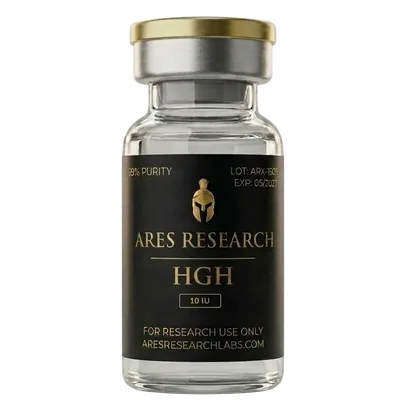
HGH (somatropin) — recombinant 191aa human growth hormone, lyophilized and COA-tested to a ≥99% purity standard, studied in endocrine and GH–IGF-1 signaling research. Laboratory research use only.
Advanced metabolic research compound. Studied in metabolic and energy pathway models. High-purity research-grade material.
Synthetic Thymosin Beta-4 fragment studied in actin-binding, cell-migration, and angiogenesis research endpoints.
Selective peptide examined in growth hormone secretagogue research.
Questions
- Is HPLC or mass spectrometry more important?
- Neither replaces the other. HPLC quantifies purity, mass spectrometry confirms identity. A credible testing package includes both for the same lot.
- Does third-party testing prove sterility?
- No. HPLC and MS characterise purity and identity only. Sterility and endotoxin content are separate assays and should be reported separately when relevant.
Continue in this cluster
Ares Research Lab supplies material for laboratory research use only. Not for human consumption, diagnosis or treatment. Analytical documentation describes purity and identity of a chemical lot and is not evidence of clinical safety.