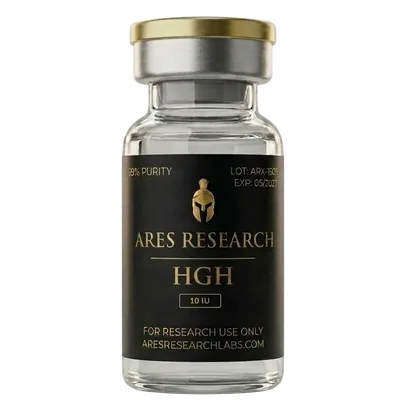
Insulin Syringe Unit Converter
A U-100 insulin syringe puts 100 graduations in one millilitre, so one unit is always 0.01 mL. What varies is the mass each unit carries — that depends on the concentration. Enter your vial and diluent volume to see both conversions at once.
- Concentration
- 5000 mcg / mL
- Concentration
- 5.00 mg / mL
- Per syringe unit
- 50.0 mcg / unit
- Draws per vial
- 10.0
- Total solution
- 100 units
Every figure below is arithmetic performed in your browser. Nothing here is a protocol, recommendation, or medical guidance — all Ares Research materials are supplied for in-vitro laboratory research only.
The conversion table that never changes
On a U-100 barrel: 10 units is 0.1 mL, 25 units is 0.25 mL, 50 units is 0.5 mL, and 100 units is a full 1 mL. This mapping is fixed by the syringe standard and is independent of what is in the solution. Multiply mL by 100 to get units; divide units by 100 to get mL.
What changes is mcg per unit
One unit of a 5,000 mcg/mL solution holds 50 mcg. One unit of a 1,000 mcg/mL solution holds 10 mcg. Same syringe, same graduation, five times the mass difference. This is why a unit reading is meaningless without the concentration recorded alongside it.
U-100 versus U-40 barrels
U-40 syringes place 40 graduations in one millilitre, so one U-40 unit is 0.025 mL — two and a half times the volume of a U-100 unit. Drawing a U-100 figure on a U-40 barrel delivers 2.5× the intended volume. Confirm the barrel marking before converting; this calculator assumes U-100 throughout.
Frequently asked questions
How many units is 0.5 mL on an insulin syringe?
+
On a U-100 insulin syringe, 0.5 mL is 50 units — half a full barrel. The conversion is fixed: multiply the volume in mL by 100 to get units.
How many mL is 10 units?
+
On a U-100 syringe, 10 units is 0.1 mL. Divide any unit figure by 100 to get the volume in millilitres.
How many mcg is one unit?
+
That depends on the concentration of your solution, not on the syringe. One unit is always 0.01 mL, so it carries the concentration in mcg/mL divided by 100. At 2,500 mcg/mL, one unit is 25 mcg. Enter your vial strength and diluent volume above to see the figure for your solution.
Can I use a U-40 syringe instead of a U-100?
+
Only if you recalculate. A U-40 barrel has 40 units per millilitre, so each unit is 0.025 mL rather than 0.01 mL. A figure calculated for U-100 will deliver two and a half times the intended volume if drawn on a U-40 barrel. Always confirm the marking printed on the syringe.
How should reconstituted material be stored?
+
Once reconstituted, most research peptides are held refrigerated at roughly 2–8°C, protected from light, in the original sealed vial. Bacteriostatic water contains 0.9% benzyl alcohol, which suppresses microbial growth in the diluent. Temperature, light exposure, and repeated freeze-thaw cycles all affect stability, so consult the compound-specific certificate of analysis and published stability data.
Related calculators
Vial mass + diluent volume → mg/mL, mcg/mL, and mcg per syringe unit.
Any vial, any diluent volume, any target amount → concentration, syringe units, doses per vial.
Compare diluent volumes before you mix — see how each one changes the syringe reading.
Purity, storage & compliance documentation
- Peptide Purity Verification: Turning a Claim Into Evidence
- Research-Use-Only Compliance: What the Label Obligates
- How to Read a Peptide Certificate of Analysis (COA)