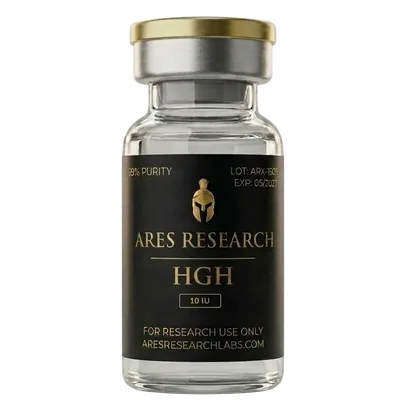
HGH vs GH-Releasing Peptides Explained
Exogenous versus endogenous: why HGH is the hormone itself while CJC-1295, Tesamorelin, and Ipamorelin are upstream release signals.
One of the most useful distinctions in growth-hormone research is also one of the least understood by newcomers: the difference between supplying growth hormone directly and signaling the body to release its own. HGH sits on one side of that line; the GH-releasing peptides sit on the other. This comparison explains the split. This is a science overview for research context only; it is not usage guidance.
Two fundamentally different approaches
Growth-hormone research divides broadly into two strategies. The exogenous approach studies growth hormone that is supplied from outside. The endogenous approach studies compounds that prompt the pituitary to release the growth hormone the body already makes. That single distinction reorganizes the entire category.
HGH — the exogenous approach
HGH (human growth hormone) is the growth-hormone molecule itself. In research it represents the direct, exogenous side: the compound under study *is* the hormone, rather than a signal that triggers its release. Because of that, it's characterized very differently from the secretagogues and releasing peptides — there's no upstream signaling step involved.
GH-releasing peptides — the endogenous approach
This group includes the GHRH analogs (like [CJC-1295](/research/hubs/cjc-1295) and [Tesamorelin](/research/hubs/tesamorelin)) and the ghrelin-mimetic secretagogues (like [Ipamorelin](/research/hubs/ipamorelin)). None of them are growth hormone. Instead, each engages a receptor upstream in the release pathway, and the research interest is in the body's *own* response. This is the endogenous side of the category.
Why the distinction structures the whole category
Almost every other growth-hormone comparison — CJC vs Ipamorelin, Tesamorelin vs CJC — happens *within* the endogenous group. HGH is the one that sits outside it entirely. Understanding that HGH is the hormone while the releasing peptides are signals is the first sorting step for anyone mapping this research space.
Approach at a glance
| Category | What it is | Example compounds | Approach | |---|---|---|---| | HGH | The growth-hormone molecule | HGH | Exogenous (supplied directly) | | GH-releasing peptides | Upstream signals | CJC-1295, Tesamorelin, Ipamorelin | Endogenous (body's own release) |
The research framing
If you only remember one thing: HGH *is* the hormone; the releasing peptides are *messages about* the hormone. Every finer comparison in this category assumes you've already made that split.
*Educational / research context only. Ares Research supplies compounds for laboratory and research use. This content is not medical advice and describes no human use, dosing, or protocol.*
Related reading
Running the numbers for a protocol? Use the research calculators to convert mg, mL, and syringe units.
Related Research Articles
Semaglutide vs Tirzepatide vs Retatrutide (2026)
How single, dual, and triple receptor agonism separate semaglutide, tirzepatide, and retatrutide (GLP-3RT) in research literature.
CJC-1295 vs Ipamorelin: Mechanism Comparison
CJC-1295 is a GHRH analog and Ipamorelin is a ghrelin-mimetic secretagogue — two receptors, one system. A research-context comparison.
BPC-157 vs TB-500: Origins and Mechanisms
BPC-157 is a gastric-derived pentadecapeptide; TB-500 is a Thymosin Beta-4 fragment. Where the two recovery-research peptides actually differ.
Tesamorelin vs CJC-1295: Two GHRH Analogs
Same receptor, different structures and research histories. A within-family comparison of the two most studied GHRH analogs.
Peptide Purity Grade Explained for Researchers
Discover what is peptide purity grade and how it impacts your research. Learn to choose the right purity for your experiments wisely.
HPLC Testing Explained for Research Compounds
Unlock the secrets of HPLC testing explained for research compounds. Dive deep into method development and data validation for reliable results!
Neutral, moderated research discussion. Laboratory use only.
More compound guides, hubs, and educational research materials.