
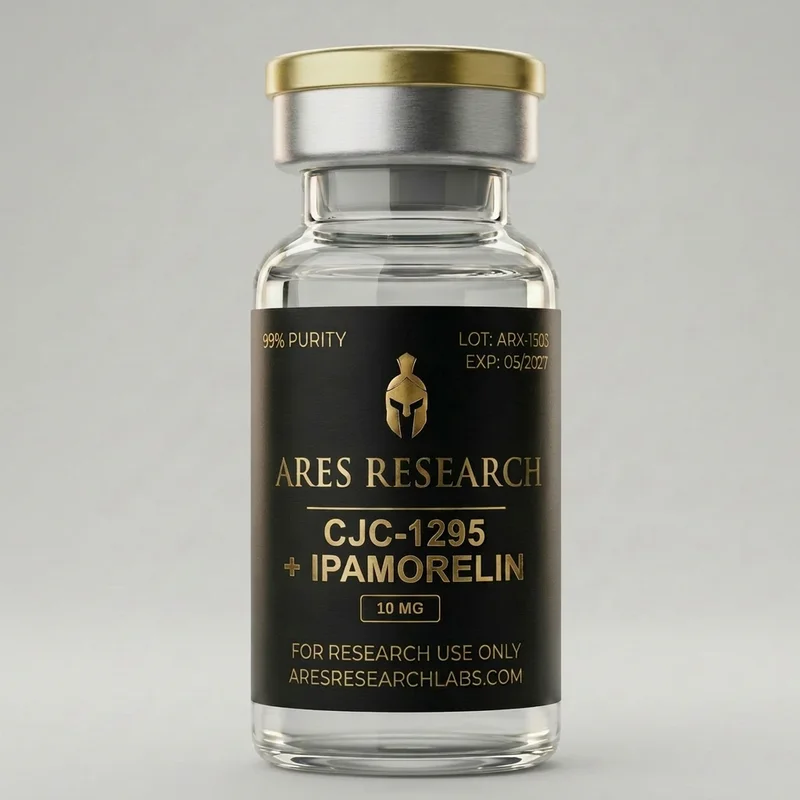
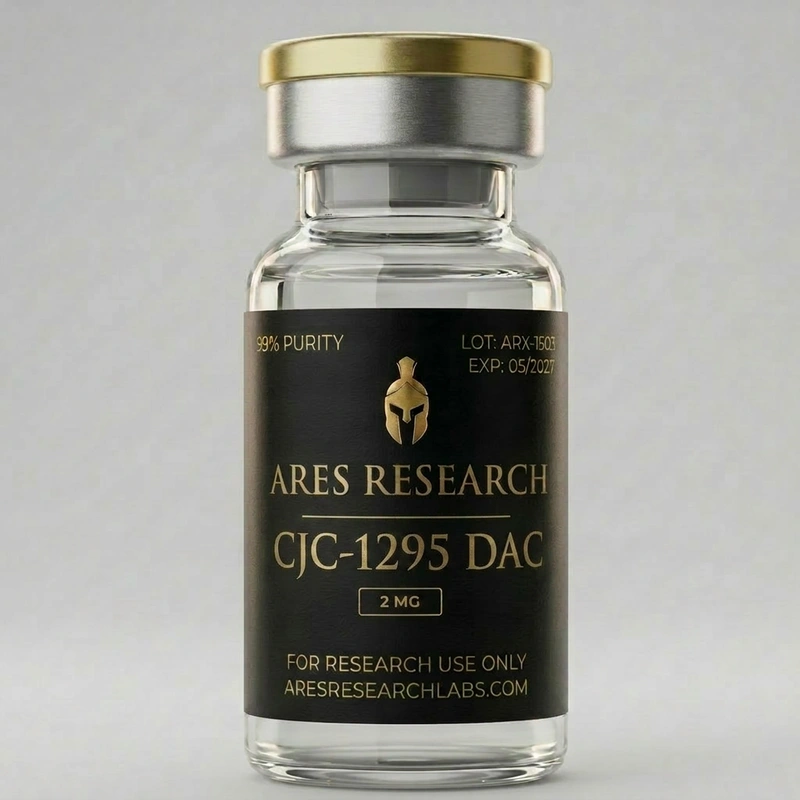
CJC-1295 + Ipamorelin Blend
Same-day shipping — Ships next business day, cutoff 3 PM ET.
≥99% purity verified by independent HPLC and mass spectrometry (MS) through Janoshik Analytical. Intended for laboratory research use only; not for human consumption, diagnosis, or treatment. View transparency report Compliance PDFs
Documentation & standards
- How to Read a Peptide Certificate of Analysis (COA)
- Peptide Storage and Handling: Temperature, Light and Stability
- Research-Use-Only Compliance: What the Label Obligates
Studied in growth hormone secretion and peptide signaling research models.
Mix and match any items — discount applies automatically at checkout.
Reminder email when it's time to reorder. No card on file. Cancel anytime from your account — or email support@aresresearchlab.com.
Batch transparency
- Batch / lot
- Released with your order
- Testing lab
- Janoshik Analytical
- Purity (HPLC)
- ≥99% target spec
- Identity (MS)
- Available on request
- Report issued
- Available on request
- Full PDF report
- By request
Every request returns a reference number and a live status page. See all published batch records →
For laboratory research use only — not for human or veterinary use.
Earn 64 loyalty points on this purchase · 100 pts = $5 off
Create a Research Account to unlock full batch data, COAs, and priority releases.
Intended strictly for research and laboratory use only. Not for human consumption.
About CJC-1295 + Ipamorelin Blend
Third-party purity testing available upon request.
Research Classification
Storage Information
CJC-1295 + Ipamorelin Blend Purity & COA Verification
For laboratory research use only. Not for human consumption, diagnosis, or treatment.
CJC-1295 + Ipamorelin COA and third-party testing
Every batch is independently analysed before release. HPLC measures purity against a ≥99% standard, mass spectrometry confirms molecular identity, and the published panel records heavy-metals, endotoxin and sterility screening where applicable. The COA is tied to the batch number printed on the vial, so the result can be verified at source rather than taken from a summary claim.
Testing documentation is supplied for laboratory research use only and does not support human, veterinary, diagnostic or therapeutic use.
What is the CJC-1295 + Ipamorelin blend?
This vial pairs CJC-1295, a synthetic GHRH analog, with ipamorelin, a selective ghrelin-receptor (GHS-R) mimetic. The two peptides engage separate receptors, which is why laboratory work frequently examines them as a combined input rather than in isolation.
Published research on the pair has looked at how GHRH-receptor and ghrelin-receptor signalling interact when measured in the same model, along with the associated IGF-1 marker readouts. These describe measurements recorded in research settings only and do not establish an effect, benefit or suitability for any person.
CJC-1295 + Ipamorelin blend specifications
| Compound | CJC-1295 + Ipamorelin (combined research blend) |
|---|---|
| Class | GHRH analog paired with a selective ghrelin-receptor (GHS-R) mimetic |
| Purity standard | ≥99% per component (HPLC, identity confirmed by mass spectrometry) |
| Physical form | Lyophilised powder in a sealed glass vial |
| Available vial size | 10mg blend vial |
| Storage | Refrigerated and protected from light; batch handling documentation included |
| Testing | Third-party COA covering identity, purity, heavy metals, endotoxins and sterility |
| Origin | Synthesised and shipped domestically (USA) |
| Intended use | Laboratory research use only — not for human or veterinary use |
CJC-1295 + Ipamorelin research questions
+What is the CJC-1295 + Ipamorelin blend?
It is a single research vial containing two peptides: CJC-1295, a synthetic GHRH analog, and ipamorelin, a selective ghrelin-receptor (GHS-R) mimetic. The two act on different receptors, which is why research models frequently examine them together rather than separately. It is supplied strictly as analytical research material.
+Why are CJC-1295 and ipamorelin studied together?
The two compounds engage separate signalling pathways — GHRH-receptor activation and ghrelin-receptor activation. Published laboratory work has examined how those two inputs interact when measured in the same model, which is the reason the pair is commonly prepared as a combined reference material. This describes research measurement only and implies no effect or benefit for any person.
+How does this differ from the standalone CJC-1295 vial?
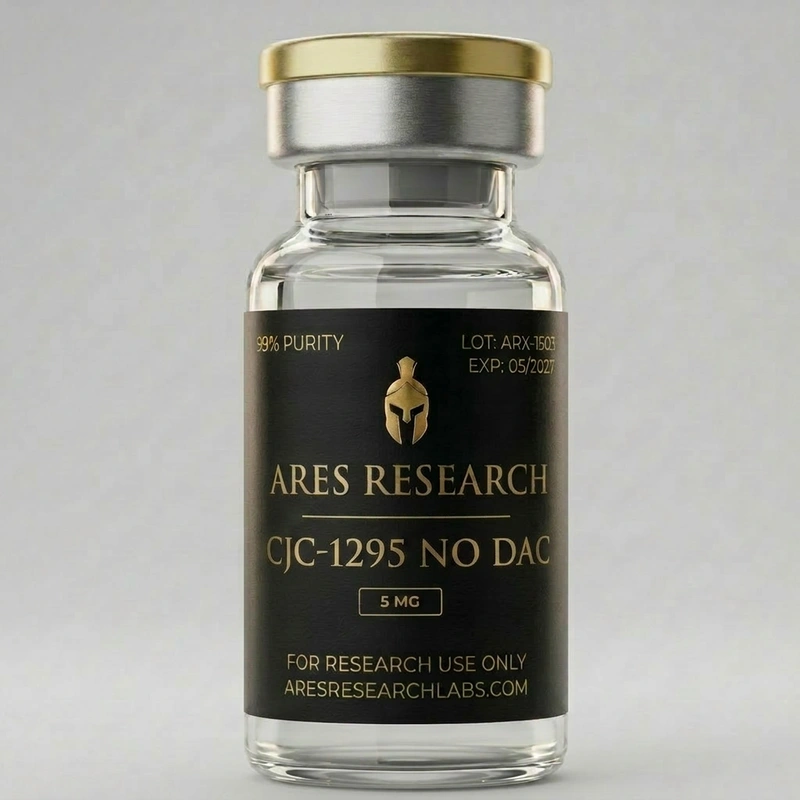
The standalone vial contains CJC-1295 (No-DAC) only and is used where a single GHRH-analog input is wanted, including work comparing the DAC and No-DAC forms. This blend vial contains both CJC-1295 and ipamorelin for combined-input study designs.
+Is a COA available for the blend?
Yes. Each blend batch is independently analysed before release, and the COA is tied to the batch number printed on the vial so the result can be verified at source. Batch reports can be looked up on the COA page.
+What purity standard applies to the blend?
Each peptide component is measured by HPLC against a ≥99% standard with identity confirmed by mass spectrometry, and the published panel records heavy-metals, endotoxin and sterility screening where applicable.
+How is the blend shipped and stored?
Vials ship domestically from the USA in protective packaging. Material should be kept refrigerated and protected from light; batch handling documentation is included. Research use only — not for human or veterinary use.
CJC-1295 + Ipamorelin Blend — Compound Information & Scientific Literature
Reference data for laboratory personnel: molecular identity, storage and stability handling, our analytical testing panel, and peer-reviewed literature indexed on PubMed.
Molecular Profile
| Compound | CJC-1295 + Ipamorelin Blend |
|---|---|
| Molecule type | GHRH + GHRP |
| Class | GHRH + GHRP |
| Catalog category | Growth Hormone |
| Physical format | Lyophilized vial |
| Components | CJC-1295 (GHRH analog) · Ipamorelin (GH secretagogue pentapeptide) |
- CJC-1295 (GHRH analog)
- Ipamorelin (GH secretagogue pentapeptide)
Handling Reference
-20 °C, protected from light and moisture
24 months from date of manufacture in the sealed vial
2-8 °C (refrigerated), do not freeze after reconstitution
Stability studied out to approximately 28 days under continuous refrigeration
Analytical Testing Panel
Verified by Janoshik Analytical — full panel, every batch. Second independent lab confirmation is being added batch by batch.
Quantifies the main peak against related-substance peaks, so the stated purity percentage is measured rather than assumed.
Every CJC-1295 + Ipamorelin Blend lot passes all 8 stages before it is released. Expand a stage to see the method and why we run it.
- Method on the COARP-HPLC (UV 214 nm)Why Ares runs it
Quantifies the main peak against related-substance peaks, so the stated purity percentage is measured rather than assumed.
- Method on the COAQuantitative HPLC mass/concentration assayWhy Ares runs it
Confirms the vial actually contains the labeled amount — purity alone says nothing about how much material is in the vial.
- Method on the COAMass Spectrometry (ESI-MS)Why Ares runs it
Confirms the measured molecular mass matches the declared compound — the check that catches a mislabeled or substituted vial.
- Method on the COAICP-MSWhy Ares runs it
Screens for elemental contaminants carried over from synthesis, reagents, or packaging.
- Method on the COAMembrane filtration, USP <71> methodologyWhy Ares runs it
Checks the finished lyophilized vial for microbial growth after fill and closure.
- Method on the COALAL assay (kinetic chromogenic)Why Ares runs it
Measures bacterial endotoxin load, a contamination marker that purity testing alone will not reveal.
- Method on the COAIndependent batch review against release specificationWhy Ares runs it
Ties the analytical numbers back to the paperwork — the lot you receive is the lot on the certificate.
- Method on the COALC-MS/MS targeted screenWhy Ares runs it
A contamination check most research suppliers never run, and the reason we run it on every batch regardless of compound.
PASS reflects the batch release standard every lot must meet before it ships. Per-lot results are published on that lot's Certificate of Analysis.
Peer-Reviewed References
Continuous 24-hour intravenous infusion of recombinant human growth hormone (GH)-releasing hormone-(1-44)-amide augments pulsatile, entropic, and daily rhythmic GH secretion in postmenopausal women equally in the estrogen-withdrawn and estrogen-supplemented states
Evans WS et al. · The Journal of clinical endocrinology and metabolism, 2001 · PMID 11158034
View sourceDifferential pulsatile secretagogue control of GH secretion in healthy men
Norman C et al. · American journal of physiology. Regulatory, integrative and comparative physiology, 2013 · PMID 23485864
View sourceHistory to the discovery of ghrelin
Bowers CY · Methods in enzymology, 2012 · PMID 22975043
View sourceRecombinant human GHRH(1-44)NH2: clinical utility and therapeutic development program
Ehlers MR · Endocrine, 2001 · PMID 11322496
View source
References are listed for literature-identification purposes only. Ares Research is not affiliated with the authors, journals, or institutions cited.
This material is supplied for laboratory and research use only. It is not for human or veterinary use, and it is not a drug, food, or cosmetic. These statements have not been evaluated by the Food and Drug Administration. No information on this page is intended to diagnose, treat, cure, or prevent any condition.
How Ares compares for CJC-1295 + Ipamorelin
Independent, documentation-first breakdowns of the vendors researchers most often ask about for this compound. COA verification, US shipping, and sourcing transparency, side by side.
Research Use Disclaimer
Researcher Reviews
Sign in with the account that placed your order to leave a verified review.
Ask the Lab
No public questions yet — be the first to ask.
All testing documentation and COA data are provided for laboratory research use only and are not intended to support human consumption, diagnostic, or therapeutic use.
More from Growth Hormone
CJC-1295 + Ipamorelin vs…
Researchers often weigh CJC-1295 + Ipamorelin against these alternatives. Spec-by-spec breakdowns: